
Cleaning Solar Panels with Drones
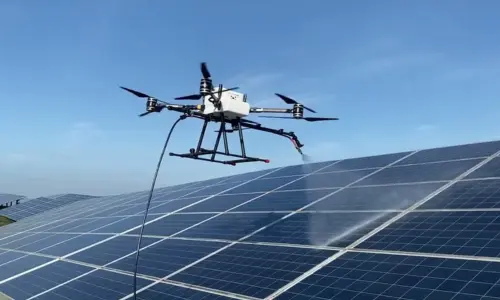
As solar farms in India continue to expand, traditional cleaning methods often struggle to keep pace with the scale. That’s where drone-based solar panel cleaning comes in. Using unmanned aerial vehicles equipped with air blowers, or spraying systems, drones can clean large areas of solar arrays quickly, safely, and with minimal human labor.
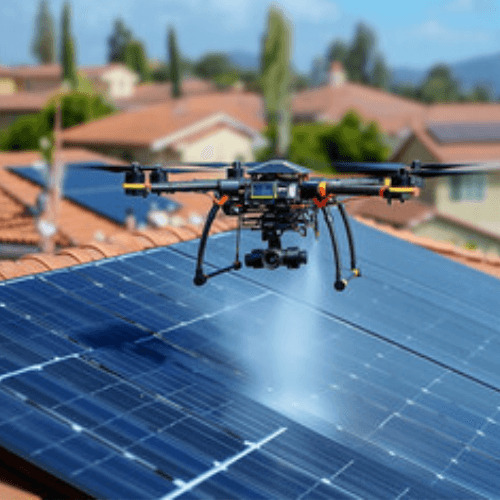
How Drone-Based Solar Panel Cleaning Works
High-precision navigation: Drones use GPS and AI-guided mapping to fly accurately over solar arrays.
Integrated cleaning mechanisms: Some drones are fitted with water sprayers while others use air jets for dust removal.
Automated operation: Cleaning patterns are pre-programmed to cover maximum surface area efficiently.
Water-saving technology: Many drone systems are designed to use purified water or operate in waterless mode, making them ideal for arid regions.
Drone Cleaning for Different Applications
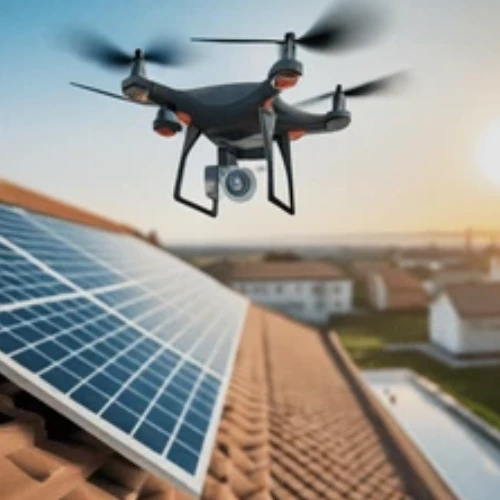
Residential Rooftops

Commercial Buildings
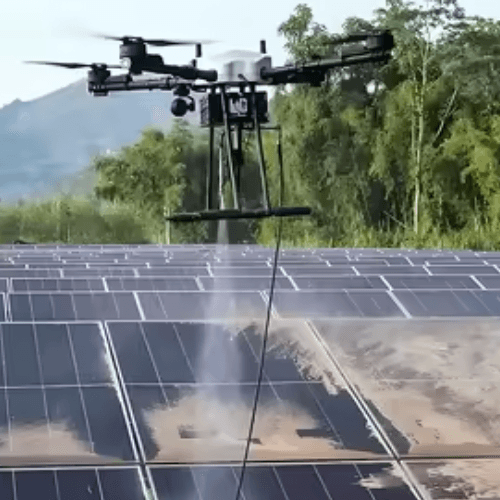
Utility-Scale Solar Farms
Future of Drone Solar Cleaning in India
With India’s push towards 500 GW renewable capacity by 2030, drone-based cleaning is expected to grow rapidly. As technology improves, drones will become:
- More affordable for mid-sized projects.
- Equipped with AI for dust hotspot detection.
- Integrated with IoT-based monitoring systems for smart solar O&M.
Challenges of Drone-Based Cleaning
- Initial Investment – High setup costs for drone purchase or service contracts.
- Regulations – Drone flying requires DGCA compliance and permissions.
- Limited Payload – Smaller drones may not carry large water tanks; advanced models are required for spraying.
- Weather Dependency – Strong winds and rain can affect drone cleaning operations.
Drone Solar Panel Cleaning in India
In India, drone technology is increasingly being used for O&M (Operation & Maintenance) of solar plants. Companies like Synergy Solar are exploring this technology for clients who demand:
- Large-scale cleaning without labor-intensive operations.
- Eco-friendly cleaning methods in water-scarce zones (Rajasthan, Gujarat, Telangana).
- Automation & remote monitoring to reduce operational costs.
Benefits of Cleaning Solar Panels with Drones
Cost-Effective in the Long Run
Reduces manpower needs and ensures higher energy yield.
Time-Saving
Cleaning that would take days manually can be completed in hours.
Water Conservation
Uses up to 90% less water compared to traditional cleaning.
Safety and Accessibility
Eliminates risks of manual labor on tall rooftops or hard-to-reach areas.
Efficiency at Scale
FAQs – Cleaning Solar Panels with Drones
What is drone-based solar panel cleaning?
Drone-based solar cleaning uses unmanned aerial vehicles equipped with water sprayers or air blowers to remove dust and dirt from solar panels efficiently and safely.
Why use drones instead of manual cleaning?
Manual cleaning is labor-intensive, risky on rooftops, and time-consuming for large solar farms. Drones reduce human risk, save time, and clean more panels with minimal resources.
Are drones safe for solar panels?
Yes. Professional drones are designed with fine mist sprayers that clean without scratching or damaging the solar glass surface.
How much water do drones use compared to traditional cleaning?
Drones use up to 70–90% less water than manual washing methods, making them ideal for water-scarce regions.
Is drone cleaning suitable for residential rooftops?
Drone cleaning is more cost-effective for large commercial and utility-scale solar farms. For small residential systems, manual cleaning is usually more economical.
What is the cost of drone solar panel cleaning in India?
Costs vary based on system size, drone technology, and service frequency. Utility-scale plants often sign annual O&M contracts that include drone cleaning as part of routine maintenance.
Do drones work in all weather conditions?
No. Drone cleaning cannot be carried out during strong winds, heavy rains, or storms. Ideal conditions are calm, dry weather.