
General
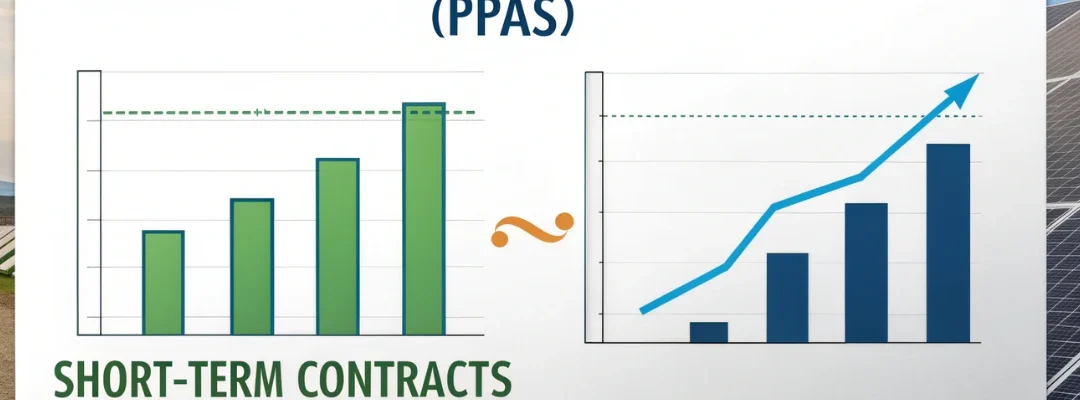
Solar Long-Term PPAs vs. Short-Term Contracts: What’s Right for Your Business?
Introduction
As India accelerates toward its 500 GW renewable energy goal, businesses are increasingly turning to solar energy to cut costs and meet sustainability goals.
But there's a key question that many corporate energy buyers face:
Should we lock in a long-term Power Purchase Agreement (PPA) or opt for a short-term solar contract?
Each model comes with its own set of benefits and trade-offs — and the right choice depends on your business strategy, cash flow stability, and risk appetite.
What is a Long-Term PPA?
A long-term PPA is a contract (typically 15–25 years) where the buyer agrees to purchase solar power from a developer at a fixed tariff.
Popular in:
- Utility-scale solar projects
- Corporate and industrial procurement
- Group captive solar parks
Advantages
- Tariff Lock-in: Protection from rising electricity rates over decades
- Easier Financing: Long-term cash flow certainty makes projects bankable
- Investor Appeal: Developers and financiers prefer long-term visibility
- Sustainability Alignment: Matches RE100, net-zero, and ESG goals
Disadvantages
- Lower Flexibility: Locked into terms for 15–25 years
- Opportunity Cost: May miss out if future market tariffs drop
- Exit Penalties: Terminating early can trigger financial penalties
What is a Short-Term Solar Contract?
A short-term solar agreement (1–5 years) allows businesses to procure solar power without a long-term commitment.
Popular in:
- Open access markets
- SMEs or companies new to solar adoption
- Businesses anticipating operational changes
Advantages
- Flexibility: Easily switch developers or renegotiate terms
- Low Commitment: Good for trial runs or uncertain demand
- Speed: Faster to structure and sign
Disadvantages
- Price Instability: No protection from market volatility
- Financing Challenges: Lenders may see short-term PPAs as risky
- Not Ideal for Big Projects: Developers hesitate without long-term security
Head-to-Head Comparison: Long-Term vs. Short-Term Solar Agreements
| Factor | Long-Term PPA (15–25 yrs) | Short-Term Contract (1–5 yrs) |
|---|---|---|
| Tariff Stability | High – Fixed for decades | Low – Prone to fluctuation |
| Flexibility | Low | High – Switch anytime |
| Financing & Bankability | Strong | Weak |
| Ideal Use Case | Large corporates, solar parks | SMEs, pilot solar users |
| Risk Exposure | Low | Medium to High |
| Setup Time | Longer (due diligence) | Faster |
Real-World Case Studies
Tech Park in Bengaluru (Long-Term PPA)
- 20-year PPA at ₹4.5/unit
- Grid tariffs rose to ₹8/unit
- Annual savings: ₹12–15 crore
- Enhanced sustainability ranking for global clients
Manufacturing SME in Gujarat (Short-Term Contract)
- Chose 3-year PPA at ₹4.9/unit
- Tariff renewal jumped to ₹6.3/unit after expiry
- Net savings dropped by 40% in year four
Lesson: Long-term PPAs offer financial insulation and ESG alignment; short-term contracts provide flexibility but carry renewal risks.
When Should You Choose Which?
| Choose Long-Term PPA If... |
|---|
| You have stable energy demand over the next 10–20 years |
| You want to secure funding and lower cost of capital |
| You have RE100 or sustainability reporting mandates |
| You want to lock in predictable OPEX |
| Choose Short-Term Contract If... |
|---|
| You’re just testing solar as a new strategy |
| Your operations may relocate, expand, or scale down |
| You want rapid deployment with minimal commitment |
| You’re in a policy-uncertain state or transitioning business model |
The Future of Contract Models in Indian Solar
India’s maturing solar market is seeing:
- Hybrid models (e.g. 5-year lock-ins with renewal clauses)
- Greater adoption of open access and group captive PPAs
- State-level policies encouraging longer tenure PPAs for grid stability
- Corporate ESG mandates driving preference for long-term solar procurement
As regulations evolve and energy prices fluctuate, businesses that balance flexibility with foresight will benefit most.
Planning solar?
Get a free site survey and subsidy guidance
Our engineers size the system to your bill and roof, handle the subsidy paperwork and install it end to end.
How much land does a solar farm need?
Roughly 4–5 acres per MW for ground-mounted plants, depending on module type, layout and spacing.
How does a solar farm earn income?
By selling power under a PPA to a DISCOM or a business, through open access, or by captive use. Returns depend on tariff, location and financing.
What does Synergy handle for a solar farm?
Feasibility, land and approvals support, design, EPC installation, commissioning and O&M.
Keep reading
Related articles
Tamil Nadu Budget 2026: ₹1 Lakh Rooftop Solar Subsidy Under PM Surya Ghar
Why Solar Insurance Is Essential for Protecting Your Investment
Top Benefits of Solar Insurance for Homes and Businesses
Free site survey · Written quote
Planning solar? Get a free site survey
Share your monthly electricity bill and roof size. Our engineers size the system, explain the subsidy and send a written quote.