
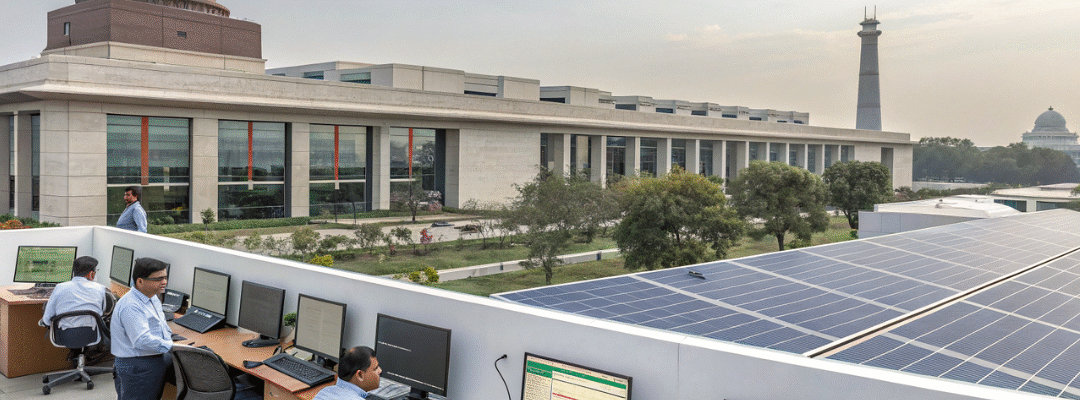
India’s Solar Growth & Policy Challenges
How Government IT Infrastructure is Speeding Up Solar Adoption in India
Introduction: Digital Transformation Fuels Renewable Growth
India’s rapid shift to solar isn’t only about panels, inverters, and subsidies. It’s also about the digital backbone powering this transition.
From online subsidy applications to smart grids and GIS mapping, government-led IT infrastructure is making solar adoption faster, more transparent, and more affordable. This digital push is a key driver in helping India achieve its ambitious 500 GW renewable energy target by 2030.
1. Centralized Portals for Subsidy Applications
Earlier, applying for solar subsidies meant paperwork, delays, and repeated visits to DISCOM offices. Now, MNRE’s National Rooftop Solar Portal and state-level platforms allow:
- Online subsidy applications under the Pradhan Mantri Surya Ghar: Muft Bijli Yojana.
- Digital dashboards to track approvals and payments.
- Direct Benefit Transfer (DBT): Subsidies are deposited directly into consumer bank accounts.
Result: Faster disbursal, reduced corruption, and greater consumer trust.
2. Digital DISCOM Systems & Net Metering Approvals
Distribution companies (DISCOMs) are going digital to simplify rooftop solar adoption:
- Online net metering applications instead of manual submissions.
- Digital verification of documents and capacity approvals.
- Automated scheduling for site inspections and meter installations.
Result: Shorter approval cycles, less paperwork, and a smooth experience for households and businesses.
3. Smart Grids & Real-Time Monitoring
Government-backed IT systems are modernizing India’s power infrastructure through:
- Smart meters that track both consumption and solar generation in real time.
- Remote monitoring platforms that ensure accurate credit settlements for net metering.
- Data analytics and forecasting tools that help DISCOMs balance renewable energy flows.
Result: More reliable solar integration and transparent billing for consumers.
4. GIS Mapping & Rooftop Potential Assessment
Using Geographic Information Systems (GIS):
- Cities are mapped for rooftop solar potential.
- Residents can check if their rooftop is solar-suitable through online tools.
- Policymakers identify solar-friendly zones for faster project deployment.
Result: Data-driven planning instead of guesswork.
5. IT Support for Financing & Awareness
Digital platforms are also improving financing and consumer awareness:
- Online loan integration with banks and NBFCs on solar portals.
- ROI calculators and savings estimators on government websites.
- Public dashboards showing state-wise adoption progress, inspiring more citizens to join the movement.
6. Blockchain & Digital Certificates
Emerging IT tools are being tested to strengthen transparency:
- Blockchain for tracking Renewable Energy Certificates (RECs).
- Traceability of green energy to avoid double counting.
- Peer-to-peer trading pilots, allowing consumers to sell surplus solar directly to neighbors.
Result: More accountability, trust, and consumer participation in renewable energy markets.
Challenges & The Road Ahead
Despite progress, a few gaps remain:
- Lack of uniform IT systems across all states and DISCOMs.
- Need to expand digital literacy in rural areas.
- Stronger cybersecurity measures to safeguard consumer and energy data.
Addressing these challenges will further accelerate India’s path toward solar-led energy independence.
Planning solar?
Get a free site survey and subsidy guidance
Our engineers size the system to your bill and roof, handle the subsidy paperwork and install it end to end.
How often should solar panels be cleaned?
Usually every 2–4 weeks, more often in dusty or coastal areas. Dirty panels can lose a noticeable share of output.
Do you service systems installed by other companies?
Yes. We inspect, repair, clean and upgrade existing solar systems, including repowering older plants.
How do I request a service visit?
Call or WhatsApp us, or send your location and system size through the enquiry form. Our nearest team will schedule the visit.
Keep reading
Related articles
India’s Road to Energy Independence: How Solar Can Replace Oil & Coal
India vs Global Solar Adoption: Why Germany & Australia are Ahead, and How India Can Catch Up
The Future of Solar in India: 1 Crore Homes to Go Solar by 2027
Free site survey · Written quote
Planning solar? Get a free site survey
Share your monthly electricity bill and roof size. Our engineers size the system, explain the subsidy and send a written quote.