
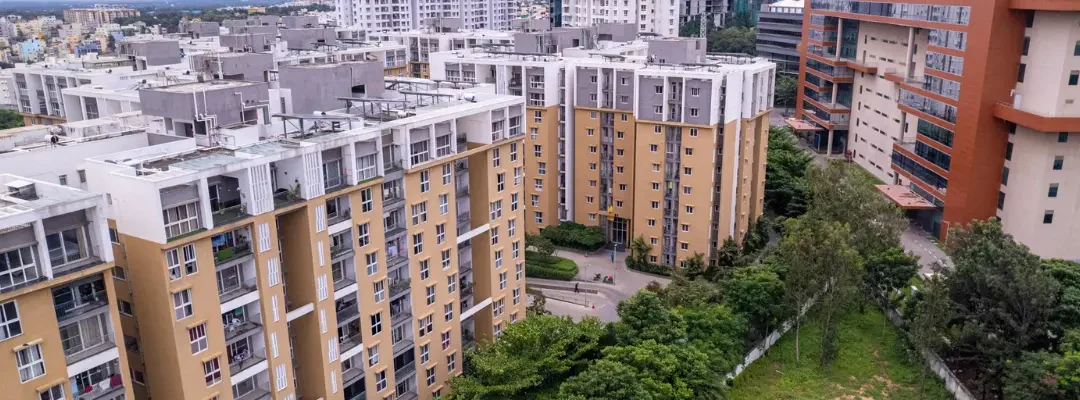
Residential & Housing Societies
ROI & Payback Period of Housing Society Solar Projects – Data-Driven Insights & Case Studies
Introduction
For any housing society, the first question before investing in solar is simple: “How fast will we get our money back?”
The good news is that solar is not just an eco-friendly choice — it’s also one of the safest financial investments a society can make. Unlike other expenses, a solar system pays for itself within a few years and then generates free electricity for the next 20+ years.
In this blog, we’ll break down:
- What ROI (Return on Investment) means for societies
- How to calculate the payback period
- Real examples from different system sizes
- Case studies of societies already saving with solar
Understanding ROI in Solar for Housing Societies
- ROI (Return on Investment) means the percentage of profit your society earns each year compared to the initial investment.
- Payback Period is the time it takes for savings from solar to equal the cost of the system.
After the payback period, the society enjoys free electricity for decades, lowering monthly maintenance charges for residents.
Payback Period Calculation – Examples
Let’s see how ROI works for different solar plant sizes commonly used in housing societies.
Example 1: 25 kW Solar Plant
- Investment: ~₹12 lakhs
- Annual Generation: ~37,000 units
- Annual Savings: ~₹3 lakhs
- Payback: ~4 years
- Lifetime Savings (25 years): ₹60–70 lakhs
Example 2: 50 kW Solar Plant
- Investment: ~₹22–25 lakhs
- Annual Generation: ~75,000 units
- Annual Savings: ~₹6 lakhs
- Payback: ~3.5–4 years
- Lifetime Savings: ₹1.2–1.5 crore
Example 3: 100 kW Solar Plant
- Investment: ~₹40–45 lakhs
- Annual Generation: ~1.5 lakh units
- Annual Savings: ~₹12–15 lakhs
- Payback: ~3.5 years
- Lifetime Savings: ₹3–4 crore
With subsidy support, payback reduces by 6–12 months, making ROI even more attractive.
Factors That Affect ROI
- Electricity Tariff – Higher local power rates = faster savings.
- System Size – Larger plants have better efficiency and ROI.
- Subsidy & Financing Model – CAPEX gives highest ROI; OPEX gives steady savings without upfront investment.
- Maintenance – Regular AMC ensures full generation and prevents revenue loss.
- Net Metering – Enables export of surplus units for maximum benefit.
Case Studies – Real Housing Society ROI Results
Case Study 1: Green Meadows Society, Mumbai
- Installed: 120 kW rooftop solar
- Investment: ₹50 lakhs
- Annual Savings: ₹18 lakhs
- Payback: 3 years
- Lifetime Savings: ₹4+ crore
- Impact: Monthly maintenance charges reduced by 20%.
Case Study 2: Sunrise Apartments, Bangalore
- Installed: 80 kW rooftop solar
- Investment: ₹35 lakhs
- Annual Savings: ₹11 lakhs
- Payback: 3.2 years
- Residents: Over 200 families now pay ₹500–700 less per month in maintenance.
Solar ROI vs Other Investments
| Investment Type | Annual ROI | Risk |
|---|---|---|
| Bank FD | 6–7% | Very low |
| Mutual Funds | 10–12% | Moderate–High |
| Stock Market | 12–15%+ | High |
| Solar for Housing Societies | 20–25% | Very low (guaranteed by savings) |
This shows why solar is not just an energy solution, but also a safe financial investment for housing societies.
Planning solar?
Get a free site survey and subsidy guidance
Our engineers size the system to your bill and roof, handle the subsidy paperwork and install it end to end.
What size solar system does my home need?
Divide your average monthly units by about 120 to get a rough kW size (1 kW makes around 4 units a day in most of India). A home using 300–400 units a month usually needs 3 kW. We confirm the size after a free site survey.
How much subsidy can I get for a home system?
Under PM Surya Ghar: Muft Bijli Yojana, homes get a central subsidy of ₹30,000 per kW for the first 2 kW and ₹18,000 for the third kW, up to ₹78,000 for systems of 3 kW and above. Some states add their own top-up. We register your application on the national portal and handle the DISCOM paperwork.
How much roof space is needed?
Plan roughly 80–100 sq ft of shade-free roof per kW. A 3 kW system needs about 250–300 sq ft.
Keep reading
Related articles
Operations & Maintenance (O&M) of Solar Plants in Housing Societies – AMC Plans, Cost Savings & Real Examples
Net Metering for Housing Societies – Process, Savings & Challenges
10 Common Mistakes Housing Societies Make When Installing Solar
Free site survey · Written quote
Planning solar? Get a free site survey
Share your monthly electricity bill and roof size. Our engineers size the system, explain the subsidy and send a written quote.