
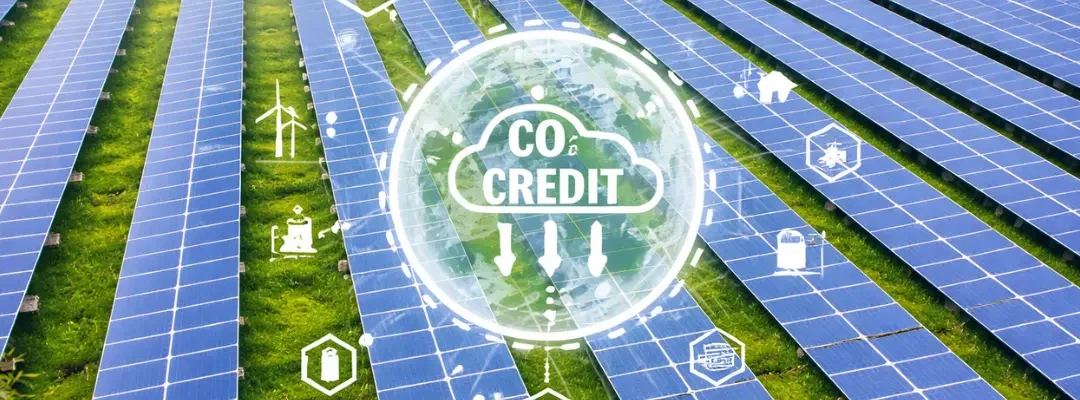
Solar farms do more than generate electricity — they help reduce greenhouse gas emissions by displacing fossil‑fuel power. In carbon markets, these emissions reductions can translate into carbon credits — an additional revenue stream for solar project owners.
What Are Carbon Credits?
A carbon credit is a tradable certificate representing one tonne of carbon dioxide equivalent (tCO₂e) that has been avoided or removed from the atmosphere through verified climate action.
In simple terms:
- Your solar farm replaces electricity that would have been generated by fossil fuels.
- This displacement reduces CO₂ emissions.
- The avoided emissions can be quantified and certified as carbon credits.
These credits can be sold, traded, or retired — giving you financial benefit and environmental recognition.
How Solar Farms Create Carbon Credits
Solar installations create carbon credits by reducing emissions. Each megawatt‑hour (MWh) of solar electricity displaces a corresponding amount of fossil fuel generation, directly cutting CO₂ emissions.
Key Steps in the Process:
- Establish a Baseline
Estimate the CO₂ emissions that would have occurred without the solar farm (based on grid or diesel alternative generation). - Measure Emission Reductions
Track actual energy output and calculate the avoided emissions per standard methodology. - Certification & Verification
Work with an accredited verifier (under standards like Verra, Gold Standard, UNFCCC/CDM, or India’s emerging frameworks). - Issue Carbon Credits
Verified reductions are converted into carbon credits (e.g., 1 credit = 1 tCO₂e). - Trade/Monetize Credits
Sell credits on carbon markets — national, voluntary, or international.
This ensures emissions reductions are credible, measurable, and market‑ready.
Carbon Credit Standards & Certification
To monetize carbon reductions from a solar farm, you must conform to recognized standards. Verified Carbon Standard (VCS), Gold Standard, or Clean Development Mechanism (CDM) are common international protocols.
In India, a new domestic carbon market is emerging under the Carbon Credit Trading Scheme (CCTS), which includes voluntary frameworks for renewable energy projects.
These schemes require:
- Project registration
- Third‑party verification
- Ongoing monitoring
- Accurate emissions calculations
Once certified, your credits can be traded or sold to entities seeking offsets.
Types of Carbon Credits Solar Farms Can Generate
Solar farms typically generate voluntary carbon credits, as they demonstrably avoid emissions rather than directly remove carbon from the atmosphere.
Two Main Markets:
- Voluntary Carbon Market (VCM) — Buyers purchase credits to meet internal sustainability or ESG goals.
- Compliance Market (Emerging in India) — Under programs like CCTS, credits may be used for regulatory purposes or ecosystem obligations.
Both have distinct price and demand drivers.
Benefits of Carbon Credits for Solar Projects
Solar farm owners can enjoy multiple advantages:
1. Extra Revenue Stream
Carbon credits can be sold to corporations, exporters, or utilities seeking to offset emissions, creating additional income beyond electricity sales.
2. Enhanced Project Economics
When combined with power sales and renewable incentives, carbon credit income improves overall return on investment.
3. ESG & Sustainability Branding
Corporate buyers increasingly seek renewable offsets for ESG reports, net‑zero targets, and sustainability claims.
4. Strategic Positioning
As carbon markets mature — especially in India — integrating credits into your solar investment strategy can future‑proof long‑term value.
How to Register and Sell Solar Carbon Credits
Here’s a simplified action plan:
Step 1: Choose a Carbon Standard
International (Verra, Gold Standard) or national (India’s emerging frameworks under CCTS).
Step 2: Baseline & Monitoring
Install measurement systems to collect generation and avoided emissions data.
Step 3: Third‑Party Verification
An accredited body reviews data and methodology to confirm legitimacy.
Step 4: Issuance of Credits
Once verified, carbon credits are issued.
Step 5: Market Sale
Sell credits via carbon exchanges, brokers, or directly to companies seeking offsets.
This ensures credibility in global or domestic carbon markets.
Real Impact: Solar Projects & Carbon Reduction
Solar farms contribute in measurable ways:
- Large parks like Bhadla Solar Park avoid millions of tonnes of CO₂ annually by replacing fossil fuel electricity generation.
- Clean energy projects in rural areas have been documented to reduce emissions at scale.
Each avoided tonne of CO₂ is a quantifiable economic and environmental outcome — which your project can convert into assets via carbon credits.