As the world increasingly recognizes the urgency of addressing climate change and reducing reliance on fossil fuels, solar energy has emerged as a promising solution. While most discussions about solar panels often focus on standalone homes, apartment dwellers or those living in flats can also benefit from this sustainable energy source. In this article, we will explore the feasibility, benefits, types of solar installations, and considerations for solar panels for flats.
Understanding the Basics
Solar panels, or photovoltaic (PV) panels, convert sunlight into electricity that can be used to power homes and appliances. They are modular in design and can be installed on rooftops, balconies, or as part of a community solar project. For those living in flats, the challenge of limited space or ownership rights can make installation more complex, but recent innovations and legislative changes have opened new possibilities.
Benefits of Solar Panels for Flats
Reduced Energy Bills: Utilizing solar energy can significantly lower electricity bills. Depending on the size of the installation and energy consumption, flats can either go off-grid or drastically reduce reliance on the main energy supply.
Environmental Impact: Solar energy is clean and renewable. By switching to solar power, flat owners contribute to reducing carbon footprints and fostering a sustainable future.
Increase Property Value: Homes with solar installations often command higher market value, making home solar solutions a wise investment.
Grid Independence: For those keen on sustainability, solar panels can provide a degree of independence from the grid. This is especially appealing in times of rising energy prices or unreliable power supplies.
Community Solutions: For residents in multi-unit buildings or flats, community solar programs allow multiple tenants to invest in a single solar installation, sharing the benefits.
Types of Solar Setups for Flats
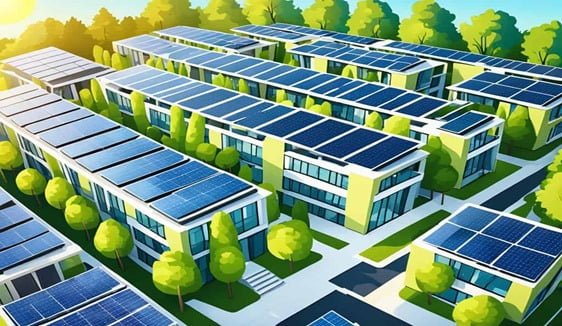
Rooftop Solar Installations: If your flat has access to rooftop space, installing solar panels there is often the most straightforward approach. It’s essential to check with the building's management and local regulations.
Balcony Solar Panels: For residents without rooftop access, balcony-mounted solar panels can be an excellent alternative. These compact systems can be affixed to balconies and provide power for common areas or individual units.
Community Solar Projects: If individual installation is not feasible, consider participating in community solar projects. These setups allow multiple households to invest in a shared solar array, generating power that can offset individual energy bills.
Building Integrated Photovoltaic (BIPV): BIPV systems can be integrated into the building materials, like windows and walls, providing a seamless aesthetic while generating energy for the building.
Considerations Before Installation
Building Regulations: Before proceeding with solar panel installation, it’s crucial to understand local building codes, regulations, and restrictions. Some homeowners associations (HOAs) or condominium boards may have specific rules regarding the installation of solar panels.
Structural Integrity: Ensure that the building structure can support solar panel installations, especially for rooftop setups. It’s advisable to consult with structural engineers if necessary.
Orientation and Sunlight Access: For maximum efficiency, solar panels should face toward the equator (south in the Northern Hemisphere), and there should be minimal obstruction from trees, other buildings, or structures that could cast shadows.
Installation Costs and Aesthetics: Evaluate the upfront costs against potential savings on energy bills. Additionally, consider how the installation will affect the aesthetic appeal of the flat, especially if the building has specific architectural guidelines.
Financing Options: Many financing models are available for solar installations, including cash purchases, loans, leases, or power purchase agreements (PPAs). Research to find the best fit for your financial situation.
Conclusion
Solar panels represent an exciting opportunity for flat residents looking to reduce energy costs, contribute to environmental sustainability, and enhance their property’s value. While challenges exist, advancements in technology and increasing support for renewable energy initiatives make it easier than ever for those living in flats to embrace solar solutions. By understanding the available options and considering local regulations, apartment dwellers can harness the power of the sun and enjoy the benefits that come with it.
Solar power is transforming how we think about energy. Clean, renewable, and increasingly cost-effective, solar energy harnesses the sun’s power to generate electricity—reducing both utility bills and carbon footprints. But how does it actually work? Let’s explore the process in detail.
What Is Solar Energy?
Solar energy is derived from the radiant light and heat emitted by the sun. Using advanced technology like photovoltaic (PV) panels and solar inverters, this natural resource is captured and transformed into usable electricity for homes, businesses, and even entire cities.
At the heart of solar power systems are photovoltaic panels, made of semi-conductive materials such as silicon. Here’s how the conversion process works:
Step-by-Step: From Sunlight to Usable Power
Sunlight Absorption
Solar panels absorb sunlight using photovoltaic cells, which are arranged in layers to maximize light capture.
Photovoltaic Effect Activation
When photons (light particles) strike the solar cells, they knock electrons loose—this reaction is known as the photovoltaic effect.
Generation of Direct Current (DC)
Freed electrons begin to move, creating an electrical current—this is direct current (DC) power.
Inverter Conversion (DC to AC)
Since most home appliances use alternating current (AC), a solar inverter converts DC into AC electricity.
Distribution & Usage
The converted AC electricity is either used immediately, stored in batteries (in off-grid systems), or sent to the local utility grid (in grid-tied systems).
Types of Solar Energy Systems
There are two primary types of solar power setups, each suited to different energy needs and locations:
Grid-Tied Systems
Connected to the public electricity grid.
Excess energy can be sold back to the grid, earning energy credits (known as net metering).
Off-Grid Systems
Operate independently from the grid.
Use battery storage to provide electricity during nights or cloudy days.
Ideal for remote or rural locations.
Key Benefits of Solar Power
Environmentally Friendly
Solar power reduces reliance on fossil fuels and decreases greenhouse gas emissions.
Sustainable & Infinite
As long as the sun shines, we’ll never run out of solar energy.
Financial Savings
Though there’s an initial setup cost, solar panels can significantly cut your energy bills over time.
Low Maintenance
Modern solar systems require minimal upkeep, making them a smart long-term investment.
Frequently Asked Questions
How long do solar panels last?
Most panels last 25–30 years with consistent performance and minimal degradation.
Do solar panels work on cloudy days?
Yes, though efficiency drops. Solar panels still capture diffuse sunlight.
Can I run my entire home on solar?
Yes—especially with battery backup. A proper system design is essential.
As India continues to battle climate change and rising energy demands, solar energy is becoming a central solution. To accelerate this transition, the Indian government has introduced several solar subsidy schemes that make it easier and more affordable for households, farmers, and institutions to adopt solar power.
In this guide, we'll walk you through the latest solar panel government schemes, what benefits they offer, how to apply, and why now is the best time to go solar in India.
In Key Government Solar Schemes You Should Know
1. PM Surya Ghar Yojana (Rooftop Solar Scheme) – For Homeowners
This is the government’s flagship initiative for residential rooftop solar. With rising electricity costs, this scheme helps homeowners offset bills and contribute to clean energy goals.
What's in it for you?
Up to ₹78,000 subsidy for installing rooftop solar panels (for systems up to 3kW)
Net metering: Sell excess electricity back to the grid and earn credits
No permit hassles – simplified approval & installation
2. PM-KUSUM Scheme – Empowering Farmers with Solar Pumps
Launched in 2019, PM-KUSUM provides financial support for farmers to adopt solar irrigation systems, reducing their dependency on expensive diesel and unreliable grid power.
Scheme Highlights:
60–70% subsidy for solar pump installation
Can be used on-grid or off-grid
Additional income opportunity by selling surplus power
Goal: Add 10,000 MW solar capacity through farm-level installations.
3. National Solar Mission – India’s Long-Term Solar Roadmap
Started in 2010 under the National Action Plan on Climate Change, this mission lays the foundation for India’s clean energy revolution.
Objectives:
Achieve 280 GW solar capacity by 2030
Promote solar R&D for cheaper, efficient tech
Support both large solar parks and decentralized rural installations
4. Solar Parks & Ultra Mega Projects – For Utility-Scale Solar Growth
To meet large energy demands, the government supports mega solar parks with shared infrastructure like transmission lines, roads, and water access.
Key Features:
Target capacity: 20,000 MW
Use of barren/degraded lands to avoid land-use conflicts
Encourages foreign and domestic investments
5. Atmanirbhar Bharat Solar Push – Boosting Made-in-India Panels
To reduce reliance on Chinese imports and promote domestic manufacturing, the government has rolled out incentives for local solar panel and component production.
Initiative Goals:
Foster self-reliance in clean tech
Strengthen India’s position as a solar hardware exporter