by trueimpactdigital | Sep 19, 2025 | Solar Panel Cleaning Equipment
Solar energy is one of the fastest-growing renewable power sources, but its efficiency depends on keeping panels clean. Dust, pollen, sand, and bird droppings can lower efficiency by 10–30%, directly affecting ROI.
Traditional cleaning methods — manual washing, tractor-mounted brushes — require high labor, water, and time. In contrast, AI-powered and autonomous cleaning machines represent a game-changing solution. They use robotics, artificial intelligence, IoT sensors, and automation to clean panels smarter, faster, and more sustainably.
What Are AI-Powered Solar Cleaning Machines?
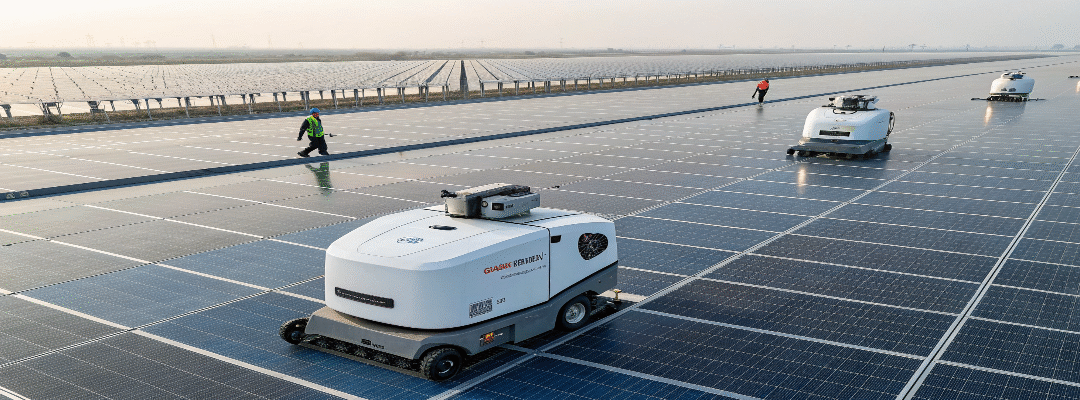
AI-powered solar cleaning machines are intelligent robotic systems that perform panel cleaning without human involvement. They are equipped with:
- Onboard sensors to detect dust and debris.
- AI-driven algorithms to optimize cleaning frequency.
- Autonomous navigation to cover entire solar fields.
- IoT connectivity for remote monitoring.
In short, they’re like a Roomba for solar farms — but designed for megawatt-scale efficiency.
Key Features and Science Behind AI Cleaning Systems
1. Autonomous Mobility
- Robots use rail systems, wheels, or tracks to travel across solar arrays.
- AI maps the farm and calculates shortest, most efficient routes.
- Some models use vision-based navigation to avoid collisions.
2. Waterless Cleaning
- Equipped with microfiber rollers, brushes, or air jets.
- Saves 7,000–10,000 liters of water per MW per cleaning cycle.
- Reduces both costs and environmental footprint.
3. Smart Cleaning Frequency
- AI analyses soiling patterns, weather forecasts, and humidity levels.
- Instead of cleaning daily, it cleans only when efficiency loss crosses 3–5%.
- Extends panel life by avoiding over-cleaning.
4. Self-Powered Operation
- Many robots recharge using small onboard solar panels.
- Minimal electricity requirement → highly energy efficient.
5. IoT & SCADA Integration
- Data syncs with the plant’s SCADA system.
- Operators can track cleaning schedules, performance, and panel yield remotely.
Real-World Benefits
Improved Energy Yield
- Keeps panels consistently clean, preventing energy dips.
- Solar farms report 8–15% more annual generation after adopting autonomous cleaners.
Reduced O&M Expenses
- Saves crores in labor and water costs every year.
- Requires just 1–2 operators for oversight instead of 100+ workers.
Longer Panel Life
- Brushes are engineered with softness < glass hardness.
- Prevents micro-scratches and degradation.
Sustainability Impact
- Reduces dependence on scarce water.
- Lowers carbon footprint by automating a resource-heavy process.
Case Studies
Rajasthan 50 MW Solar Farm
- Manual cleaning: 10 days, ₹50 lakh/year in O&M.
- AI robots: ₹1.2 crore upfront, ₹10 lakh/year O&M.
- Output increase: 12% efficiency gain → ₹8 crore annual revenue boost.
- Payback: 1.8 years.
Middle East 100 MW Project
- Desert soiling reduced energy output by 20%.
- AI-powered robots cleaned daily without water.
- Increased yield: 15% + saved 1 crore liters of water annually.
Challenges of AI-Based Cleaning Machines
- High Capital Cost: Systems range from ₹50 lakh to ₹2 crore.
- Technical Expertise: Needs skilled engineers for maintenance.
- Farm Compatibility: Works best in ground-mounted solar farms with proper row spacing.
- Weather Limits: Heavy rain or extreme winds can disrupt robotic cleaning cycles.
The Future of AI in Solar Cleaning
- Predictive Cleaning Models
AI will use weather + dust forecasting to predict soiling and schedule cleaning ahead of time. - Drone-Based Cleaning
Autonomous drones with lightweight brushes or air jets for rooftops and floating solar plants. - Self-Cleaning Nano-Coatings
Integration with hydrophobic coatings to minimize dust adhesion. - AI + Data Analytics
Cleaning robots feeding soiling maps to help investors plan O&M more efficiently.
ROI and Financial Perspective
- Upfront Investment: ₹50 lakh–₹2 crore depending on scale.
- O&M Savings: 70–90% reduction in labor and water costs.
- Energy Gains: 10–15% more annual yield = crores in revenue.
- Payback: Usually 1.5–3 years, after which cleaning becomes almost free.
For 100 MW+ solar farms, AI cleaning is not a luxury — it’s a necessity for financial sustainability.
by trueimpactdigital | Sep 19, 2025 | Solar Panel Cleaning Equipment
Large solar farms often span hundreds of acres, with thousands of panels lined up in rows. Keeping them dust-free is a challenge. While robotic cleaners are popular, many utility-scale operators in rural regions rely on tractor-mounted solar panel cleaning systems.
But are these tractors really cost-effective? Let’s explore how they work, the savings they bring, and whether they’re worth the investment.
What Are Solar Panel Cleaning Tractors?
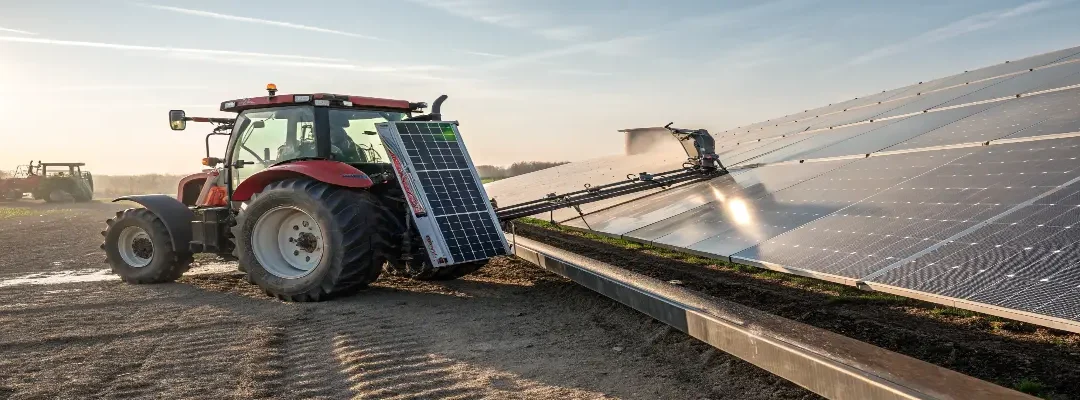
Solar panel cleaning tractors are modified agricultural tractors fitted with:
- Long rotating brushes (up to 6–8 meters wide)
- Hydraulic arms for easy reach
- Water-assisted or waterless cleaning options
They move along solar panel rows, cleaning hundreds of panels in a single run.
Why Tractors for Solar Cleaning?
- Designed for Scale – Clean large solar farms (10 MW–500 MW) quickly.
- Affordable Automation – Lower upfront cost compared to fully robotic systems.
- Rural Compatibility – Easy availability of tractors in solar-rich states like Rajasthan, Gujarat, and Madhya Pradesh.
Cost Savings with Cleaning Tractors
1. Reduced Labor Expenses
- Manual cleaning of a 50 MW farm may need 200+ workers.
- A single tractor system can replace dozens of workers.
- Annual labor savings = ₹30–50 lakh depending on site size.
2. Lower Water Usage
- Modern tractor cleaners use controlled water sprays or waterless brushes.
- Saves 20–40% water compared to tanker-based cleaning.
3. Faster Cleaning Cycles
- Cleans thousands of panels in hours, not days.
- Fewer cleaning delays → higher energy generation.
4. ROI on Investment
- Tractor cleaning systems cost ₹15–30 lakh.
- Payback in 1.5–2 years through energy gains and O&M savings.
Case Example: 25 MW Solar Farm in Gujarat
- Manual Cleaning: ₹70 lakh/year (labor + water tankers).
- Tractor Cleaning System: ₹25 lakh upfront + ₹15 lakh/year O&M.
- Annual Savings: ₹40 lakh.
- Payback Period: ~1.8 years.
- Additional Benefit: 10% higher output (~₹2.5 crore/year).
This shows tractors deliver quick ROI + long-term savings.
Limitations of Tractor Cleaning
- Not suitable for rooftop or compact layouts.
- Requires wide spacing between panel rows.
- Initial customization and setup costs.
- Higher wear-and-tear compared to static robotic systems.
Future Outlook
- Hybrid models combining tractor-mounted brushes with AI-based tracking.
- More waterless tractor attachments to save resources.
- Leasing models where O&M firms provide tractors on service contracts, reducing CAPEX burden for solar farm owners.
by trueimpactdigital | Sep 19, 2025 | Solar Panel Cleaning Equipment
Solar farms spread across hundreds of acres generate megawatts of power daily. But dust, sand, and pollution can reduce output by 10–30%, costing operators crores in lost revenue.
The solution? Solar panel cleaning machines — from robotic cleaners to tractor-mounted systems — that keep panels dust-free, reduce operating costs, and maximize ROI for large-scale solar farms.
The Cost of Dirty Panels in Solar Farms
- Dust accumulation reduces efficiency, leading to lower power generation.
- A 100 MW solar farm can lose over ₹15–20 crore annually if panels are not cleaned regularly.
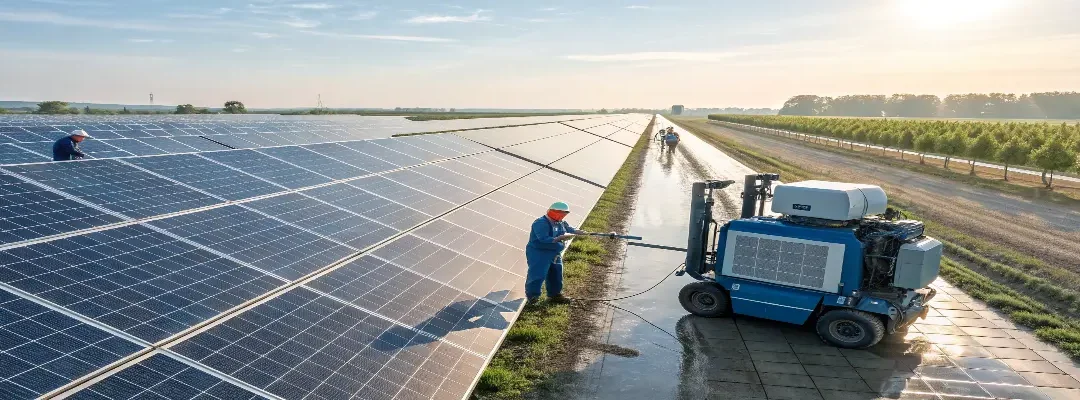
- Manual cleaning requires water tankers, labor, and time, which increases O&M costs.
How Cleaning Machines Save Money
1. Higher Energy Output = More Revenue
- Regular machine cleaning restores 10–15% more power generation.
- Example: For a 50 MW farm, even a 10% gain equals ₹5–7 crore extra revenue annually.
2. Reduced Water Costs
- Manual cleaning of 1 MW needs 7,000–10,000 liters of water.
- Robotic waterless machines save millions of liters every year.
- This reduces not only water costs but also logistics expenses.
3. Lower Labor Dependency
- Manual cleaning = hundreds of workers for large farms.
- Machines (robots or tractors) clean faster with fewer staff.
- Cuts down on recurring labor expenses and improves safety.
4. Longer Panel Life
- Machines use soft brushes/microfibers → no scratches.
- Prevents long-term damage, avoiding costly replacements.
5. Faster ROI on Solar Farms
- With higher generation and reduced O&M costs, payback periods shrink.
- Cleaning machines pay for themselves within 1–3 years.
Case Example: Rajasthan Solar Park (100 MW)
- Manual cleaning: ₹1.2 crore/year (water + labor).
- Robotic waterless cleaning machines: ₹40 lakh/year O&M.
- Annual savings: ₹80 lakh + 12% higher energy revenue (~₹18 crore).
- Payback period for machines: 2 years.
Machines Used in Solar Farms
- Robotic Waterless Cleaners → Autonomous, rail-based, AI-powered.
- Tractor-Mounted Cleaning Systems → Cover thousands of panels in hours.
- Semi-Automatic Brush Machines → Low-cost option for mid-scale farms.
The Bigger Picture: Long-Term Financial Benefits
- Operational Savings: Lower manpower, water, and logistics costs.
- Energy Yield Maximization: Ensures farms meet PPA obligations.
- Sustainability Compliance: Waterless cleaning aligns with green goals.
- Investor Confidence: Consistent returns improve financing opportunities.
by trueimpactdigital | Sep 19, 2025 | Solar Panel Cleaning Equipment
Solar panels are designed to convert sunlight into electricity efficiently. But when dust, dirt, or bird droppings cover the surface, light absorption drops, reducing energy generation by 10–30%.
To solve this, solar panel cleaning machines use a mix of mechanical engineering, material science, and robotics. In this blog, we’ll explore the science behind these machines — from simple brushes to advanced robotic cleaners.
The Basics: Brush-Based Cleaning Systems
How They Work
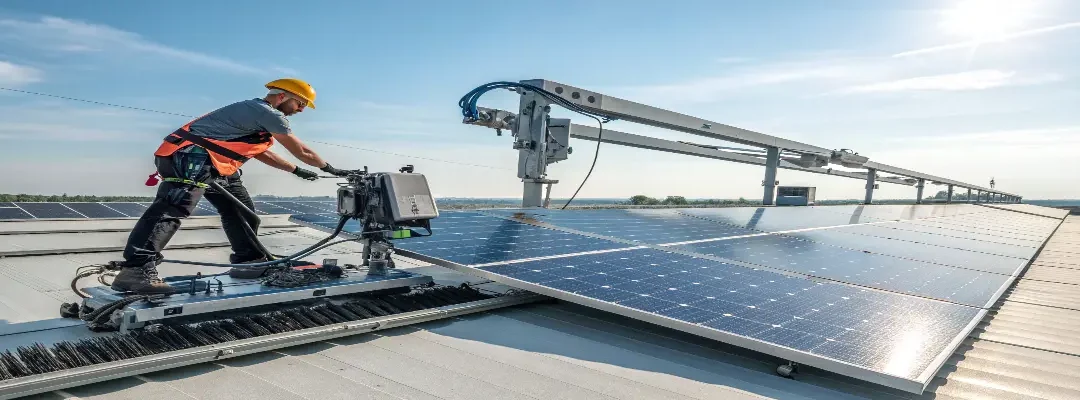
- Brushes made of soft nylon or microfiber move across the panel surface.
- Designed to avoid scratches while dislodging dust.
- Can be manual (handheld) or motor-driven (semi-automatic).
Science Behind It
- Brush bristles are engineered with low hardness (below glass surface hardness) to prevent damage.
- Microfiber materials use static charge to attract fine dust particles.
Best for residential rooftops and small installations.
Hybrid Cleaning: Brush + Water Systems
How They Work
- Combine rotating brushes with controlled water spray.
- Used for sticky dirt, bird droppings, or oily residues.
Science Behind It
- Uses the principle of lubrication + friction reduction.
- Minimal water ensures dirt loosens without damaging anti-reflective coating.
Ideal for industrial rooftops and medium solar plants.
Robotic Cleaning Machines
How They Work
- Fully autonomous robots travel across panels using tracks or rails.
- Use AI + sensors to detect dust levels.
- Operate mostly waterless, relying on microfiber rollers and suction.
Science Behind It
- Weight Distribution: Robots are designed lightweight to prevent panel stress.
- Friction Optimization: Wheels use low-friction materials to glide smoothly.
- Sensors & AI: Detect soiling patterns, optimize cleaning frequency, and avoid obstacles.
Perfect for large solar farms (MW scale).
Tractor-Mounted Cleaning Systems
How They Work
- Tractors fitted with long rotating brushes move across rows of panels.
- Cover hundreds of panels in minutes.
Science Behind It
- Uses mechanical torque from the tractor’s power to rotate brushes.
- Brush pressure is calibrated to remove dust without damaging glass.
Suited for utility-scale projects in rural areas.
Waterless Technology
One of the biggest innovations is waterless cleaning.
- Uses dry brushes or air blowers to remove dust.
- Saves 7,000–10,000 liters of water per MW per cleaning cycle.
- Often combined with robotics + automation.
A sustainable solution for arid and water-scarce regions.
Case Example: Robotic Cleaning in a 100 MW Solar Farm
- Manual cleaning → 10,000 liters of water/MW each cycle.
- Robotic waterless cleaning → Zero water use, 12% higher output.
- ROI on robots → Achieved in 2.5 years due to energy savings.
The Future of Solar Cleaning Machines
- AI & IoT Integration → Smart robots that schedule cleaning automatically.
- Drone-Based Cleaning → Experimental systems for rooftops and hard-to-reach panels.
- Self-Cleaning Nano-Coatings → Panels that repel dust, reducing cleaning frequency.
by trueimpactdigital | Sep 19, 2025 | Solar Panel Cleaning Equipment
Solar panels are a long-term investment — designed to last 20–25 years. However, their performance depends heavily on cleanliness. Studies show that panels covered with dust, bird droppings, or pollution can lose 10–30% of efficiency.
For residential users, this means higher electricity bills. For solar farms, it can mean crores of rupees in lost revenue.
This is where solar panel cleaning machines step in. By automating the cleaning process, they improve energy generation, extend panel life, and maximize ROI.
Why Dirty Panels Hurt ROI
- Reduced Sunlight Absorption → Dust blocks photons from reaching solar cells.
- Hotspot Formation → Uneven dirt causes temperature imbalances that damage panels.
- Accelerated Degradation → Dirt + moisture lead to corrosion over time.
In short: dirt = lower output + faster wear + higher costs.
How Cleaning Machines Improve Energy Generation
1. Consistent Cleaning
Manual cleaning is irregular, but machines ensure panels are cleaned daily or weekly. This consistency keeps energy output stable.
2. Higher Efficiency
- Clean panels = up to 15% more generation.
- In high-dust zones (Rajasthan, Gujarat, Middle East), gains can be even higher (20–25%).
3. Automated Precision
Machines use soft brushes, microfiber rollers, or robotics that remove dust without scratching. Unlike manual cleaning, they maintain uniform quality.
4. Water Conservation
Many cleaning machines are waterless — saving thousands of liters of water while still delivering clean panels.
ROI: The Financial Impact of Cleaning Machines
Example 1 – Residential Rooftop (10 kW system)
- Without cleaning: 12% efficiency loss = ~1,500 units lost/year (~₹12,000).
- With machine cleaning: Recovers losses + saves on manual labor.
- ROI: Machine cost recovered in 2–3 years through savings.
Example 2 – Industrial Rooftop (500 kW system)
- Annual loss due to dirt: ₹8–10 lakh.
- Cleaning machine (semi-automatic/robotic) cost: ₹5–7 lakh.
- Payback: <1 year, then pure savings.
Example 3 – Solar Farm (50 MW)
- Energy loss due to dust: ~₹10–15 crore/year.
- Robotic cleaning investment: ₹2–3 crore.
- Payback: 1.5–2 years, with 12–15% higher output.
Across all scales, cleaning machines pay for themselves quickly and keep delivering returns
Types of Cleaning Machines That Boost ROI
Manual Brush Systems
- Cost: ₹15,000–₹50,000.
- Suitable for small rooftops.
- ROI via reduced electricity bills.
Semi-Automatic Machines
- Motor-driven brushes.
- Suitable for housing societies and commercial rooftops.
Robotic Cleaners
- AI-powered, waterless systems.
- Best for solar farms and industries.
- ROI driven by efficiency gains + labor savings.
Tractor-Mounted Systems
- Large rotating brushes fitted on tractors.
- Ideal for utility-scale solar parks (10 MW+).
- Saves crores annually.
Long-Term Financial Benefits
1. Shorter Payback Period
- Dirty panels delay ROI by reducing generation.
- Regular cleaning ensures faster project payback.
2. Higher Lifetime Savings
- 25-year project life → crores in additional revenue if panels stay clean.
3. Lower O&M Costs
- Saves on labor, water, and time.
- Predictable, automated cleaning reduces management overhead.
4. Enhanced Asset Value
- Investors and lenders prefer assets with reliable performance.
- Clean panels = higher valuation of solar projects.
Case Study – Rajasthan 100 MW Solar Farm
- Pre-cleaning generation: 155 million units/year.
- Loss due to dust (15%): 23 million units/year (~₹16 crore).
- After adopting robotic cleaning: Output restored + water saved.
- ROI on cleaning machines: Achieved in under 2 years.
Challenges & Considerations
- Initial Investment: Machines require upfront costs.
- Customization Needs: Layouts differ; machines must fit row spacing & tilt.
- Training: Operators need basic training for advanced systems.
However, the long-term savings far outweigh these challenges.
The Future of ROI from Cleaning Machines
- AI-Powered Cleaning Robots → Predict soiling and clean only when needed.
- IoT Integration → Remote performance monitoring.
- Drone-Based Cleaning → Next-gen solutions for rooftops and floating solar.
- Leasing/OPEX Models → Societies and farms can adopt cleaning machines without upfront cost.