
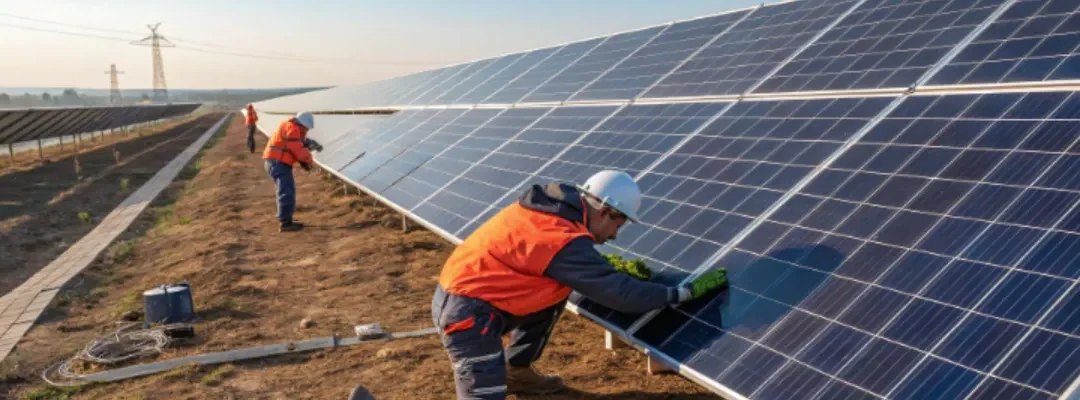
Even though solar farms are designed to be low-maintenance, technical issues can arise that significantly reduce performance, affect ROI, and increase downtime. Timely detection and resolution of these problems are essential for ensuring long-term efficiency and operational stability.
In this blog, we cover the most common technical problems in solar farms, their impact, and proven strategies to resolve or prevent them.
1.Inverter Failures
Problem:
Inverters are critical components that convert DC from panels into AC for grid use. Overheating, poor ventilation, or internal component degradation can cause frequent shutdowns or failures.
Resolution:
- Use high-quality, properly rated inverters
- Ensure adequate ventilation and dust protection
- Perform regular thermal inspections to identify hotspots
- Monitor inverter data remotely for performance anomalies
Tip: Always maintain spares for quick inverter replacement to reduce downtime.
2. DC Cable Degradation & Connection Failures
Problem:
Loose, oxidized, or damaged cables reduce power flow, increase resistance, and can even cause arcing or fire risks.
Resolution:
- Conduct periodic visual inspections and thermal scans
- Use UV-resistant and high-quality cables
- Implement proper cable management and secure routing
- Replace damaged connectors and seal joints to prevent moisture ingress
3. Soiling and Dust Accumulation on Panels
Problem:
Dust, pollen, bird droppings, and industrial residue block sunlight and reduce power generation by up to 30%.
Resolution:
- Establish a scheduled cleaning plan (manual or robotic)
- Install dust control windfences around solar arrays
- Use anti-soiling coatings where applicable
- Monitor cleaning intervals based on weather and output data
4. Shading from Vegetation or Nearby Structures
Problem:
Unexpected shadows from growing trees, fencing, or construction nearby can reduce string output or trip MPPT functionality.
Resolution:
- Perform regular site inspections
- Trim vegetation and remove temporary obstructions
- Design layout using shading analysis tools
- Utilize module-level power electronics (MLPE) to isolate shaded panels
5. Mounting Structure Corrosion or Loosening
Problem:
Over time, mounting frames may loosen or corrode, especially in coastal or high-humidity areas, risking panel alignment and safety.
Resolution:
- Use hot-dip galvanized or anodized aluminum structures
- Schedule torque checks on fasteners
- Inspect for rust or corrosion and replace affected parts
- Apply anti-corrosive coatings in high-risk zones
6. Energy Loss Due to Module Mismatch or Degradation
Problem:
Not all solar panels age uniformly. Mismatch losses occur when one or more modules degrade faster, pulling down the performance of the entire string.
Resolution:
- Use flash-tested panels with matching electrical characteristics
- Perform IV curve testing to detect underperforming modules
- Consider bypass diodes or microinverters for improved isolation
- Replace degraded panels periodically
7. Poor Monitoring and Lack of Data Visibility
Problem:
Without proper real-time monitoring, faults go unnoticed until major generation losses occur.
Resolution:
- Implement string-level or inverter-level monitoring systems
- Use cloud-based dashboards with fault alerts
- Analyze data trends monthly to catch slow degradation
- Train teams to interpret and respond to alerts proactively
8. Ground Faults and Earthing Issues
Problem:
Improper grounding leads to electric leakage, shock hazards, or fault trips, especially during rains.
Resolution:
- Ensure proper earthing design compliant with local codes
- Check resistance values regularly (less than 5 ohms is ideal)
- Use ground fault detectors on combiner boxes or inverters
- Test insulation resistance between live and ground terminals
9. PID (Potential Induced Degradation)
Problem:
PID causes gradual loss in panel performance due to high system voltage and humidity.
Resolution:
- Use PID-resistant modules
- Install PID recovery devices
- Maintain system voltage below manufacturer thresholds
- Monitor regularly in humid or coastal regions