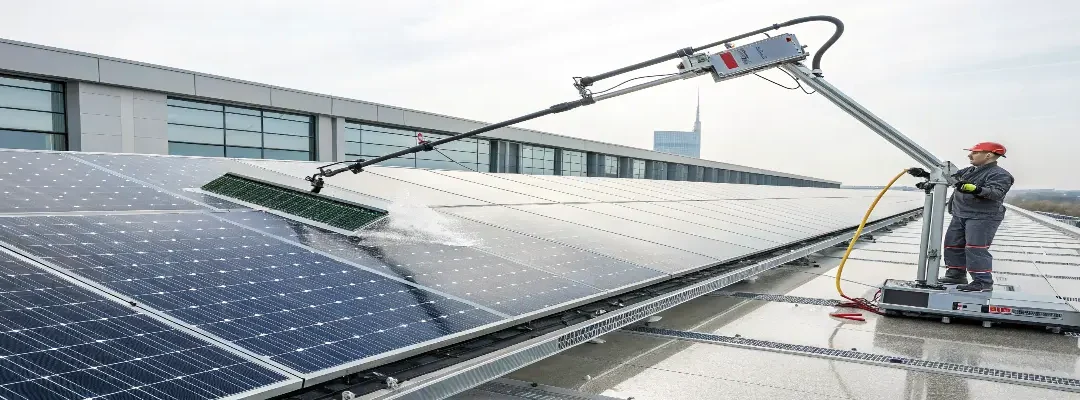
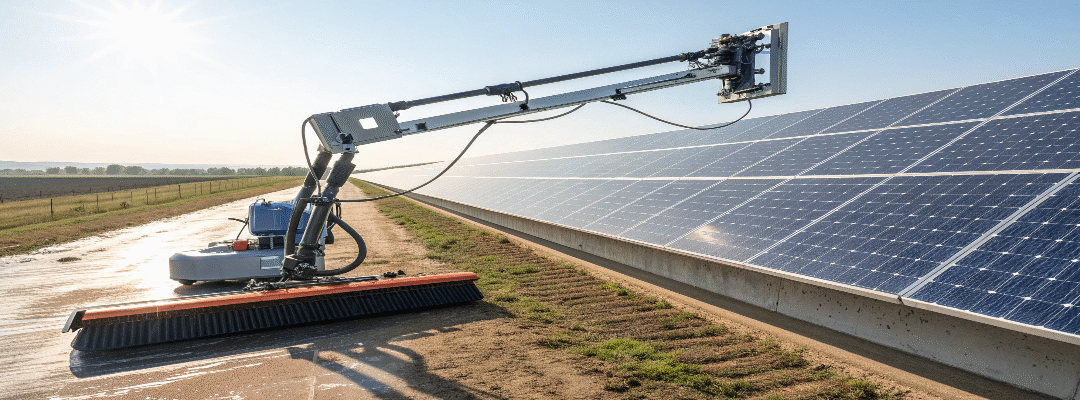
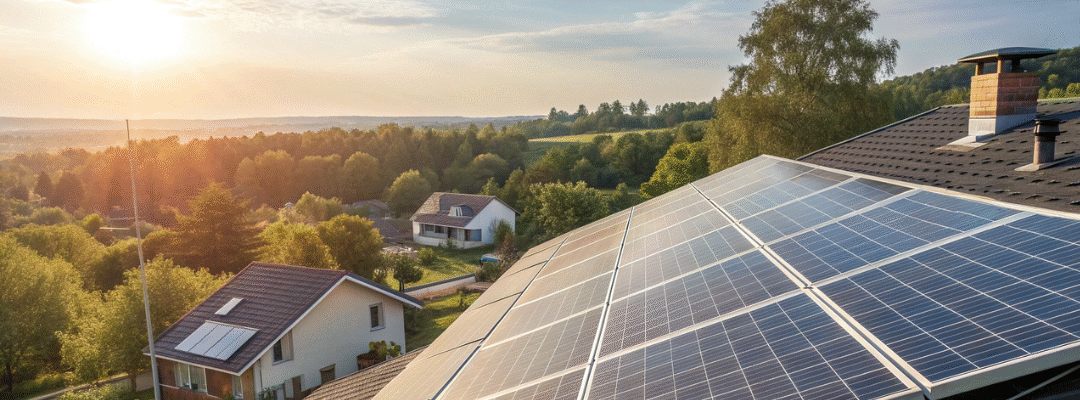
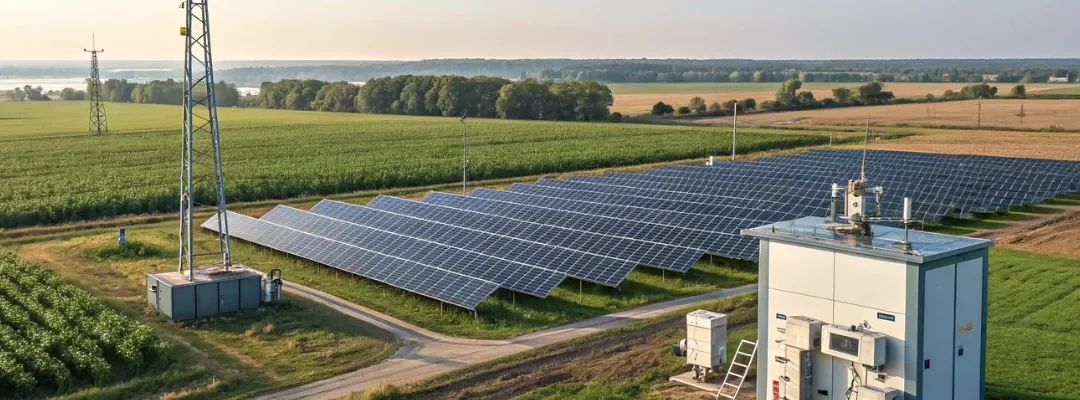
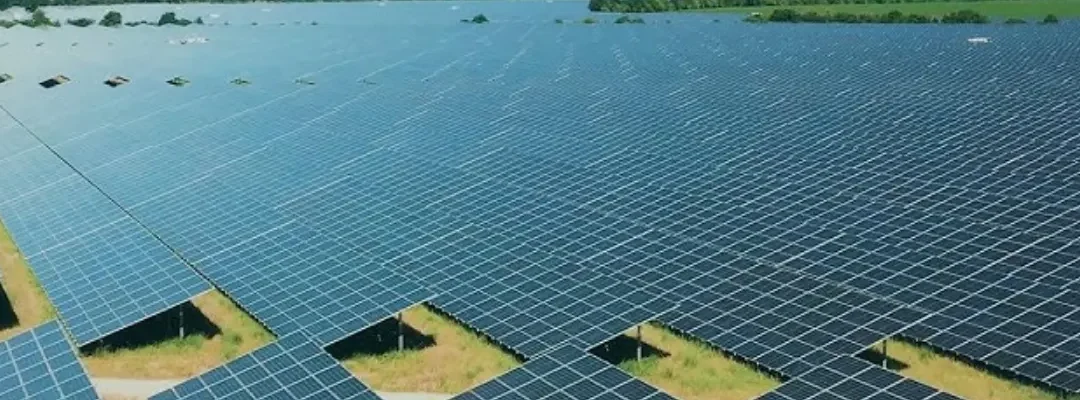
Clean solar panels = higher energy generation. But the cleaning requirements for a household rooftop system and a large solar farm are very different.
This is why solar panel cleaning machines are designed differently for residential and industrial use. In this guide, we’ll break down the key differences, costs, and benefits of both.
Residential Solar Panel Cleaning Machines
Features
Small & Lightweight: Easy for homeowners to handle.
Manual or Semi-Automatic: Typically brush-based or handheld systems.
Waterless or Low-Water Options: Conserves water for households.
Cost Range: ₹15,000 – ₹1.5 lakh depending on technology.
Best Suited For
Rooftop solar systems (2 kW – 20 kW).
Housing societies with smaller common area solar setups.
Users who prefer low-cost and simple cleaning tools.
Industrial Solar Panel Cleaning Machines
Features
Heavy-Duty Design: Built for cleaning thousands of panels at scale.
Automated/Robotic: Rail-mounted robots, tractors, or AI-powered cleaners.
High-Speed Efficiency: Can clean MW-scale solar farms within hours.
Cost Range: ₹2 lakh – ₹50 lakh+ depending on automation and capacity.
Best Suited For
Utility-scale solar farms (1 MW – 500 MW).
Large industries with captive solar plants.
EPC contractors and O&M companies managing multiple sites.
Side-by-Side Comparison
Feature
Residential Cleaning Machines
Industrial Cleaning Machines
System Size
2 kW – 20 kW
1 MW – 500 MW
Operation
Manual / Semi-Automatic
Automated / Robotic
Water Use
Waterless or minimal
Mostly waterless, high efficiency
Cost
₹15,000 – ₹1.5 lakh
₹2 lakh – ₹50 lakh+
Cleaning Speed
Few panels/hour
Thousands of panels/hour
Maintenance
Low
Medium to High
Users
Homeowners, small societies
Solar farms, industries, O&M firms
Case Example
Residential Rooftop (10 kW system, 30 panels)
Manual brush system cost: ₹20,000
Cleaning time: 30–40 minutes
Energy gain: 8–12% more efficiency
Industrial Solar Farm (50 MW, 1.5 lakh panels)
Robotic waterless cleaner cost: ₹25 lakh
Cleans entire site in <24 hours
Energy gain: 12–15% efficiency boost, saving ₹1.5–2 crore annually
Which One Should You Choose?
Go Residential Machines If: You are a homeowner or small society, with fewer panels and limited budget.
Go Industrial Machines If: You operate a large solar farm or industrial plant, where efficiency and speed directly impact ROI.
Both options improve performance, but the scale of your solar project determines the right choice.
Solar panels work best when they’re clean. Dust, bird droppings, and pollution can block sunlight and reduce power output by 10–30%. Traditionally, panels are cleaned with water, but in many regions — especially India, the Middle East, and Africa — water is scarce and expensive.
Enter waterless solar panel cleaning machines — an innovative, eco-friendly solution that cleans panels without wasting a single drop of water.
What Are Waterless Solar Panel Cleaning Machines?
Waterless solar panel cleaning machines are automated or semi-automated systems that remove dust and dirt using rotating brushes, microfiber pads, or robotic arms instead of water.
Mechanism: Soft brushes or rollers glide across panels.
Operation: Can be manual, semi-automatic, or fully robotic.
Technology: Some advanced machines use AI and sensors to detect dirt levels.
Why Go Waterless?
1. Water Conservation
Cleaning 1 MW of solar panels with water can require 7,000–10,000 liters.
Waterless machines eliminate this wastage — critical in arid regions.
2. Eco-Friendly & Sustainable
Reduces water consumption and carbon footprint.
Ideal for large solar farms in drought-prone areas.
3. Lower Operating Costs
No need to buy, transport, or pump water.
Saves thousands of rupees in annual cleaning expenses.
4. Better ROI
Panels stay consistently clean, ensuring maximum energy generation.
ROI improves as energy output increases by 10–15% compared to infrequent water-based cleaning.
Types of Waterless Cleaning Machines
Manual Waterless Cleaners
Lightweight, portable brush systems.
Suitable for residential rooftops.
Semi-Automatic Cleaning Machines
Motorized brush rollers, often rail-mounted.
Best for medium-sized solar installations.
Robotic Waterless Cleaners
Fully autonomous, AI-powered systems.
Designed for large solar farms and industrial plants.
Case Example: Solar Farm in Rajasthan
Capacity: 50 MW
Traditional Cleaning: 3,50,000 liters of water/month
Switched to Waterless Robots
Saved 42 lakh liters of water annually
Increased output by 12%
ROI achieved in 2 years
Challenges of Waterless Cleaning
Initial Investment: Higher than water-based cleaning.
Heavy Dust Regions: May require more frequent cleaning.
Compatibility: Some rooftop designs may need customized systems.
However, the long-term savings and sustainability benefits outweigh these challenges.
The Future of Solar Panel Cleaning
AI & IoT integration → Robots that self-schedule cleaning.
Drone-assisted cleaning → Emerging technology for rooftops.
Hybrid systems → Combining waterless cleaning with minimal water spray for sticky residues.
High electricity costs and the rising need for sustainability have pushed homeowners, businesses, and communities to explore solar energy. But many hesitate because of the hefty upfront investment required to buy and install solar panels.
This is where solar leasing comes in — a simple, affordable way to go solar without owning the system. In this guide, we’ll explain what solar leasing is, how it works, the costs involved, and why it may (or may not) be the right choice for you.
What is Solar Leasing & How It Works
Solar leasing is a financing model where you rent a solar power system instead of purchasing it. The solar provider installs and owns the panels, while you pay a fixed monthly fee or a rate based on electricity generated.
How it works in practice:
The solar company designs and installs the system at zero upfront cost.
You pay a monthly lease fee (15–25 years contract).
You consume electricity generated by the system, lowering your grid bill.
At the end of the lease, you can renew, upgrade, buy, or remove the system.
This makes solar accessible for households, SMEs, and institutions without requiring heavy investment.
Solar Leasing vs. Buying vs. PPA
Feature
Solar Leasing
Buying (CAPEX)
Power Purchase Agreement (PPA)
Ownership
Solar company
You
Solar company
Upfront Cost
₹0
High
₹0
Maintenance
Company handles
Owner responsibility
Company handles
Subsidy & Tax Benefits
Not available
Available
Not available
ROI
Moderate
Highest
High
Contract Period
15–25 years
None
15–25 years
In short:
Leasing = affordability, no ownership.
Buying = best long-term ROI.
PPA = pay only for units consumed, no fixed rent.
Benefits for Homeowners, Businesses & Industries
For Homeowners & Housing Societies
Zero upfront cost → go solar without loans.
Lower electricity bills from day one.
Hassle-free system maintenance.
For Businesses & SMEs
Fixed energy costs, protecting against grid tariff hikes.
No CAPEX burden → conserve cash for business growth.
Meets sustainability goals without complexity.
For Large Industries
Reduce carbon footprint to comply with ESG standards.
Flexible long-term contracts with predictable savings.
Strengthens green branding for global supply chains.
Yet, signing a PPA is only the first step. Implementing it comes with hurdles that can delay projects, impact bankability, or reduce investor confidence.
This article explores the three most pressing challenges — land acquisition, tariff disputes, and grid integration — along with practical solutions and lessons for stakeholders.
Challenge 1: Land Acquisition & Aggregation
The Problem
Solar parks need hundreds to thousands of acres
Land in India is highly fragmented with multiple small owners
Issues include title disputes, unclear inheritance records, and local political resistance
Impact on PPAs
Delayed commissioning → penalties for developers
Investor hesitation → reduces fund flow into projects
Solutions
Employ professional land aggregators for legal due diligence
Digitize and modernize land records (via DILRMP) to streamline verification
Best Practice Example: Karnataka’s Pavagada Solar Park, where land was leased from over 2,000 farmers, ensuring stable income for landowners and smooth aggregation for developers.
Challenge 2: Tariff & Pricing Disputes
The Problem
Developers & buyers often clash on tariff rates
DISCOMs sometimes attempt renegotiation when newer, lower tariffs emerge in auctions
Legacy PPAs at ₹6–7/unit face pressure in a market where auctions discover ₹2.5–3/unit tariffs
Impact on PPAs
Creates revenue uncertainty for developers
Erodes investor confidence in contract sanctity
May discourage long-term capital inflow
Solutions
Clear tariff clauses in PPAs, with strong legal safeguards
Encourage competitive bidding for transparent price discovery
Use escalation clauses (e.g. +2–3% annually) to balance buyer and seller interests
Case Study: In Andhra Pradesh (2019), the state attempted to renegotiate existing PPAs to lower tariffs. This sparked legal disputes, delayed projects, and raised global investor concerns about India’s contract stability.
Challenge 3: Grid Integration & Infrastructure
The Problem
Renewable plants are often located in remote, high-irradiation zones
Weak transmission networks, congestion, and curtailment limit power evacuation
Developers lose money when plants generate power but DISCOMs can’t (or won’t) evacuate it
Impact on PPAs
Lost revenue despite signed contracts
Reduced plant load factor (PLF) and overall project IRR
Solutions
Invest in Green Energy Corridors and high-capacity transmission lines
Add compensation clauses in PPAs for grid curtailment
Promote hybrid models (solar + wind + storage) to balance supply and reduce grid stress
Other Critical Challenges
Payment Delays from DISCOMs
Many state utilities struggle financially
Developers face cash flow issues due to delayed receivables
Solution: Promote corporate PPAs with creditworthy buyers
Regulatory Uncertainty
Frequent state-level policy changes (e.g., open access surcharges, net metering caps)
Solution: Push for national-level standardization of open access and PPA frameworks
Contract Enforcement Issues
Buyers may delay compliance or seek early exit
Solution: Strengthen contract enforcement mechanisms via CERC/SERCs
At a Glance: PPA Implementation Challenges in India
Challenge
Impact
Solution
Land Acquisition
Project delays, investor uncertainty
Aggregators, leasing, digital records
Tariff Disputes
Revenue uncertainty, renegotiations
Clear clauses, competitive bidding, escalations
Grid Integration
Curtailment, lower IRRs
Transmission upgrades, hybrids, compensation
Payment Delays
Cash flow stress
Corporate PPAs, escrow mechanisms
Regulatory Uncertainty
Investor confusion, policy risk
Policy harmonization, national frameworks
Contract Enforcement
Legal disputes, delays
Stronger regulatory oversight & enforcement
The Road Ahead
Despite hurdles, PPAs remain the cornerstone of renewable growth in India. To fully realize the 500 GW target by 2030:
Transparent land processes must be implemented nationwide
Tariff stability should be ensured with robust, enforceable contracts
Grid modernization is essential to handle rising renewable penetration
If these systemic issues are addressed, India will not only accelerate its solar transition but also retain investor confidence — ensuring PPAs remain the reliable engine driving clean energy growth.
For many Indian landowners, farming has always been uncertain. Dependence on monsoons, fluctuating crop prices, and rising input costs often leave families with unstable incomes.
But with India’s renewable energy boom, a new opportunity has opened up: leasing land for solar parks backed by Power Purchase Agreements (PPAs).
These agreements provide fixed, guaranteed earnings for 15–25 years, allowing landowners to enjoy stable income without investing in expensive solar infrastructure.
What is a Power Purchase Agreement (PPA)?
A Power Purchase Agreement (PPA) is a contract where:
The developer builds and maintains the solar plant.
The buyer (DISCOM, corporate, or industry) commits to buying electricity at a fixed rate for 15–25 years.
The landowner leases their land to the developer in exchange for steady rental income.
For landowners: This means your land becomes a reliable income-generating asset for decades, instead of depending solely on crop yields.
Benefits of PPAs for Landowners in Solar Parks
1. Fixed Annual Lease Income
Developers pay rent every year for 15–25 years.
Income is independent of weather or crop prices.
2. Zero Investment, Zero Maintenance
Landowners don’t spend on panels or equipment.
Developers cover all setup and O&M costs.
3. Risk-Free Returns
Unlike farming, where profits vary, PPA-backed leases ensure guaranteed income streams.
4. Increased Land Value
Land in solar zones often gains higher valuations.
Becomes a secure asset for future generations.
5. Contribution to India’s Green Future
By leasing land, farmers directly support India’s 500 GW renewable target by 2030.
Adds social prestige and environmental recognition to their role.
Real-Life Example: Pavagada Solar Park, Karnataka
13,000 acres leased by 2,300+ farmers
Each farmer earns ₹21,000–₹36,000 per acre annually
25 years of guaranteed income under PPA-backed projects
For many farmers, this income was more stable and higher than farming returns, transforming local livelihoods.
Landowner Participation Models
Model
How It Works
Pros
Cons
Lease Model
Fixed rent per acre
Safe, predictable
No upside from project profits
Revenue-Sharing
% of project revenue
Higher returns possible
Dependent on plant performance
Ownership/Partnership
Joint investment with developer
Biggest profit potential
Requires capital + higher risk
Most landowners choose the lease model for its simplicity and low risk.
Key Things Landowners Must Check
Transparent agreements with clear payment terms
Work with credible developers/EPCs only
Verify land titles and approvals before signing
Negotiate rent escalation clauses for inflation protection
Future Outlook: Solar Parks and Agrivoltaics
India’s clean energy target = massive demand for land in solar-rich states (Rajasthan, Gujarat, Karnataka, Maharashtra, Tamil Nadu).
Agrivoltaics (farming + solar) is gaining traction, letting landowners earn from both crops and solar simultaneously.
Over the next decade, solar leasing may become more profitable than agriculture in many regions.