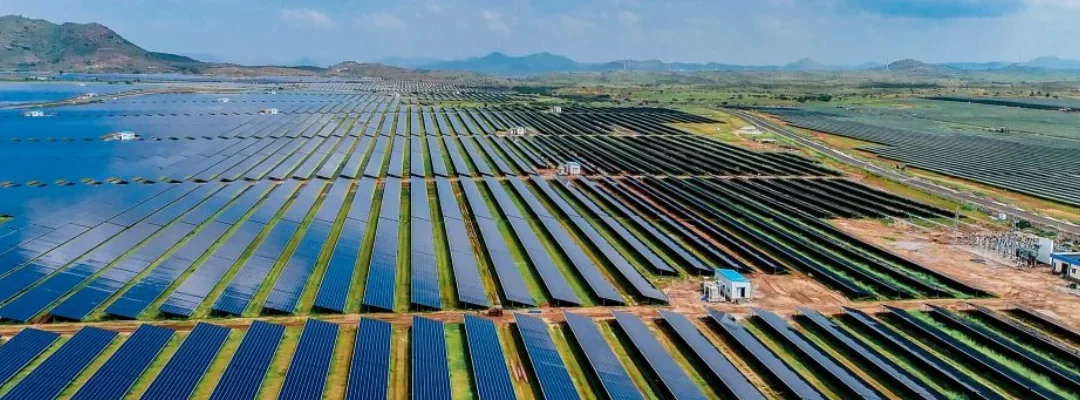
India’s journey toward achieving 500 GW of renewable energy by 2030 depends heavily on large solar parks. But behind every successful solar park lies a critical first step: land acquisition. Without clear, dispute-free land, even the most advanced solar technology cannot move forward.
This is where land aggregation plays a vital role. By consolidating fragmented plots, resolving disputes, and creating transparent agreements with farmers, land aggregators have helped shape some of India’s most iconic solar parks. Let’s look at a few case studies that show how this process works in real life.
Case Study 1: Bhadla Solar Park, Rajasthan
Capacity: 2,245 MW (world’s largest solar park)
Land Requirement: Over 14,000 acres
Challenge: Land in the Thar desert was spread across multiple owners, with boundary disputes.
Solution: Land aggregators worked with local authorities to consolidate plots, verify titles, and prepare clean land parcels.
Result: A world-class solar park that now powers millions of homes and showcases India’s renewable leadership.
Result: A world-class solar park that now powers millions of homes and showcases India’s renewable leadership.
Case Study 2: Pavagada Solar Park, Karnataka
Capacity: 2,050 MW
Land Requirement: 13,000 acres, leased from thousands of farmers
Challenge: Farmers were initially hesitant to give up agricultural land.
Solution: Land aggregators created a long-term lease model, ensuring farmers received steady annual rental income while retaining land ownership.
Result: Over 2,300 farmers benefit from stable income, while the region became a renewable energy hub.
Case Study 3: Charanka Solar Park, Gujarat
Capacity: 600 MW+
Land Requirement: 5,000 acres
Challenge: Multiple farmers with disputed land titles slowed down early development.
Solution: Aggregators facilitated dispute resolution and coordinated with the state government for faster approvals.
Result: Charanka became India’s first large-scale solar park, attracting both domestic and foreign investors.
Case Study 4: Rewa Ultra Mega Solar Park, Madhya Pradesh
Capacity: 750 MW
Land Requirement: 1,500 hectares
Challenge: Farmers demanded long-term security and were unsure about compensation.
Solution: Land aggregators worked out transparent lease agreements backed by state guarantees.
Result: Rewa solar park supplies electricity to both Madhya Pradesh and the Delhi Metro, becoming a model for future projects.
Lessons from These Case Studies
Transparency builds trust → Farmers are more willing to participate when agreements are clear and fair.
Leasing over selling → Lease models allow farmers to retain ownership while earning steady income.
Legal clarity is non-negotiable → Title verification and dispute resolution are the backbone of successful aggregation.
Partnerships matter → Collaboration between farmers, aggregators, developers, and state authorities ensures faster project execution.
For investors, clean energy isn’t just an ESG checkbox — it’s a gateway to stable, long-term returns.
In contrast to volatile equities and commodity markets, solar projects backed by Power Purchase Agreements (PPAs) offer something rare: Contracted, predictable cash flows for 15–25 years.
In this article, we break down how PPAs de-risk renewable investments and why they’re a magnet for capital in India’s booming clean energy sector.
What Is a Power Purchase Agreement (PPA)?
A Power Purchase Agreement (PPA) is a legal contract between a solar power producer and an electricity buyer (e.g. DISCOMs, corporations, or industries). It defines:
A fixed tariff (price per unit of electricity)
A long-term duration (typically 10–25 years)
Guaranteed power offtake
Investor Role: Funds and owns the project Buyer Role: Commits to purchasing electricity for the contract period
The result? Reliable, long-duration income streams — underwritten by binding commercial contracts.
Why PPAs Are Attractive for Clean Energy Investors
1. Predictable, Contracted Cash Flow
PPAs eliminate demand and price uncertainty
Revenues are guaranteed for 15–25 years
Enables accurate IRR projections and risk-adjusted returns
2. Low Exposure to Market Volatility
Insulated from electricity price swings and fossil fuel inflation
As India accelerates toward its 500 GW renewable energy goal, businesses are increasingly turning to solar energy to cut costs and meet sustainability goals.
But there's a key question that many corporate energy buyers face:
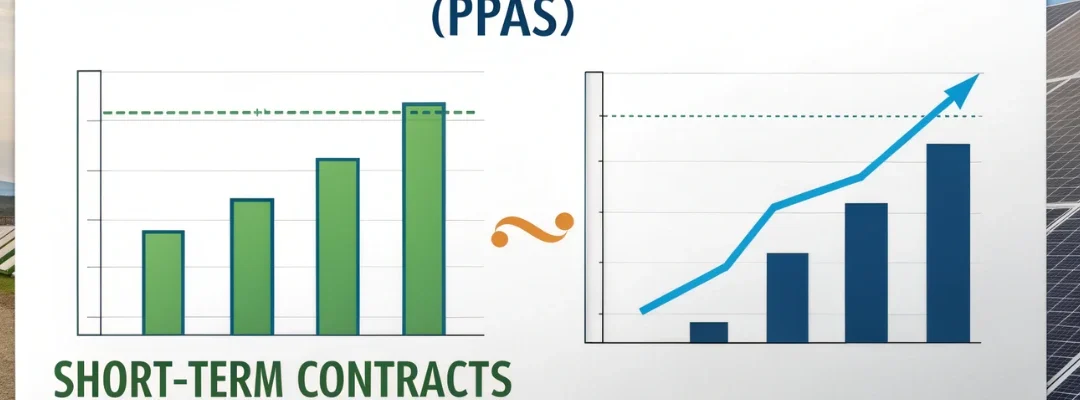
Should we lock in a long-term Power Purchase Agreement (PPA) or opt for a short-term solar contract?
Each model comes with its own set of benefits and trade-offs — and the right choice depends on your business strategy, cash flow stability, and risk appetite.
What is a Long-Term PPA?
A long-term PPA is a contract (typically 15–25 years) where the buyer agrees to purchase solar power from a developer at a fixed tariff.
Popular in:
Utility-scale solar projects
Corporate and industrial procurement
Group captive solar parks
Advantages
Tariff Lock-in: Protection from rising electricity rates over decades
Easier Financing: Long-term cash flow certainty makes projects bankable
Investor Appeal: Developers and financiers prefer long-term visibility
Sustainability Alignment: Matches RE100, net-zero, and ESG goals
Disadvantages
Lower Flexibility: Locked into terms for 15–25 years
Opportunity Cost: May miss out if future market tariffs drop
Exit Penalties: Terminating early can trigger financial penalties
What is a Short-Term Solar Contract?
A short-term solar agreement (1–5 years) allows businesses to procure solar power without a long-term commitment.
Popular in:
Open access markets
SMEs or companies new to solar adoption
Businesses anticipating operational changes
Advantages
Flexibility: Easily switch developers or renegotiate terms
Low Commitment: Good for trial runs or uncertain demand
Speed: Faster to structure and sign
Disadvantages
Price Instability: No protection from market volatility
Financing Challenges: Lenders may see short-term PPAs as risky
Not Ideal for Big Projects: Developers hesitate without long-term security
Head-to-Head Comparison: Long-Term vs. Short-Term Solar Agreements
Factor
Long-Term PPA (15–25 yrs)
Short-Term Contract (1–5 yrs)
Tariff Stability
High – Fixed for decades
Low – Prone to fluctuation
Flexibility
Low
High – Switch anytime
Financing & Bankability
Strong
Weak
Ideal Use Case
Large corporates, solar parks
SMEs, pilot solar users
Risk Exposure
Low
Medium to High
Setup Time
Longer (due diligence)
Faster
Real-World Case Studies
Tech Park in Bengaluru (Long-Term PPA)
20-year PPA at ₹4.5/unit
Grid tariffs rose to ₹8/unit
Annual savings: ₹12–15 crore
Enhanced sustainability ranking for global clients
Manufacturing SME in Gujarat (Short-Term Contract)
Chose 3-year PPA at ₹4.9/unit
Tariff renewal jumped to ₹6.3/unit after expiry
Net savings dropped by 40% in year four
Lesson: Long-term PPAs offer financial insulation and ESG alignment; short-term contracts provide flexibility but carry renewal risks.
When Should You Choose Which?
Choose Long-Term PPA If...
You have stable energy demand over the next 10–20 years
You want to secure funding and lower cost of capital
You have RE100 or sustainability reporting mandates
You want to lock in predictable OPEX
Choose Short-Term Contract If...
You’re just testing solar as a new strategy
Your operations may relocate, expand, or scale down
You want rapid deployment with minimal commitment
You’re in a policy-uncertain state or transitioning business model
The Future of Contract Models in Indian Solar
India’s maturing solar market is seeing:
Hybrid models (e.g. 5-year lock-ins with renewal clauses)
Greater adoption of open access and group captive PPAs
State-level policies encouraging longer tenure PPAs for grid stability
Corporate ESG mandates driving preference for long-term solar procurement
As regulations evolve and energy prices fluctuate, businesses that balance flexibility with foresight will benefit most.