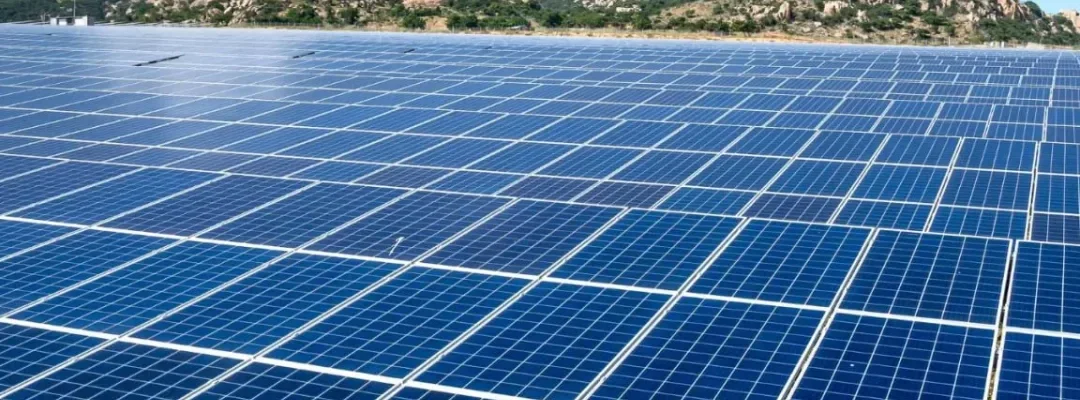
Yet, signing a PPA is only the first step. Implementing it comes with hurdles that can delay projects, impact bankability, or reduce investor confidence.
This article explores the three most pressing challenges — land acquisition, tariff disputes, and grid integration — along with practical solutions and lessons for stakeholders.
Challenge 1: Land Acquisition & Aggregation
The Problem
Solar parks need hundreds to thousands of acres
Land in India is highly fragmented with multiple small owners
Issues include title disputes, unclear inheritance records, and local political resistance
Impact on PPAs
Delayed commissioning → penalties for developers
Investor hesitation → reduces fund flow into projects
Solutions
Employ professional land aggregators for legal due diligence
Digitize and modernize land records (via DILRMP) to streamline verification
Best Practice Example: Karnataka’s Pavagada Solar Park, where land was leased from over 2,000 farmers, ensuring stable income for landowners and smooth aggregation for developers.
Challenge 2: Tariff & Pricing Disputes
The Problem
Developers & buyers often clash on tariff rates
DISCOMs sometimes attempt renegotiation when newer, lower tariffs emerge in auctions
Legacy PPAs at ₹6–7/unit face pressure in a market where auctions discover ₹2.5–3/unit tariffs
Impact on PPAs
Creates revenue uncertainty for developers
Erodes investor confidence in contract sanctity
May discourage long-term capital inflow
Solutions
Clear tariff clauses in PPAs, with strong legal safeguards
Encourage competitive bidding for transparent price discovery
Use escalation clauses (e.g. +2–3% annually) to balance buyer and seller interests
Case Study: In Andhra Pradesh (2019), the state attempted to renegotiate existing PPAs to lower tariffs. This sparked legal disputes, delayed projects, and raised global investor concerns about India’s contract stability.
Challenge 3: Grid Integration & Infrastructure
The Problem
Renewable plants are often located in remote, high-irradiation zones
Weak transmission networks, congestion, and curtailment limit power evacuation
Developers lose money when plants generate power but DISCOMs can’t (or won’t) evacuate it
Impact on PPAs
Lost revenue despite signed contracts
Reduced plant load factor (PLF) and overall project IRR
Solutions
Invest in Green Energy Corridors and high-capacity transmission lines
Add compensation clauses in PPAs for grid curtailment
Promote hybrid models (solar + wind + storage) to balance supply and reduce grid stress
Other Critical Challenges
Payment Delays from DISCOMs
Many state utilities struggle financially
Developers face cash flow issues due to delayed receivables
Solution: Promote corporate PPAs with creditworthy buyers
Regulatory Uncertainty
Frequent state-level policy changes (e.g., open access surcharges, net metering caps)
Solution: Push for national-level standardization of open access and PPA frameworks
Contract Enforcement Issues
Buyers may delay compliance or seek early exit
Solution: Strengthen contract enforcement mechanisms via CERC/SERCs
At a Glance: PPA Implementation Challenges in India
Challenge
Impact
Solution
Land Acquisition
Project delays, investor uncertainty
Aggregators, leasing, digital records
Tariff Disputes
Revenue uncertainty, renegotiations
Clear clauses, competitive bidding, escalations
Grid Integration
Curtailment, lower IRRs
Transmission upgrades, hybrids, compensation
Payment Delays
Cash flow stress
Corporate PPAs, escrow mechanisms
Regulatory Uncertainty
Investor confusion, policy risk
Policy harmonization, national frameworks
Contract Enforcement
Legal disputes, delays
Stronger regulatory oversight & enforcement
The Road Ahead
Despite hurdles, PPAs remain the cornerstone of renewable growth in India. To fully realize the 500 GW target by 2030:
Transparent land processes must be implemented nationwide
Tariff stability should be ensured with robust, enforceable contracts
Grid modernization is essential to handle rising renewable penetration
If these systemic issues are addressed, India will not only accelerate its solar transition but also retain investor confidence — ensuring PPAs remain the reliable engine driving clean energy growth.
For many Indian landowners, farming has always been uncertain. Dependence on monsoons, fluctuating crop prices, and rising input costs often leave families with unstable incomes.
But with India’s renewable energy boom, a new opportunity has opened up: leasing land for solar parks backed by Power Purchase Agreements (PPAs).
These agreements provide fixed, guaranteed earnings for 15–25 years, allowing landowners to enjoy stable income without investing in expensive solar infrastructure.
What is a Power Purchase Agreement (PPA)?
A Power Purchase Agreement (PPA) is a contract where:
The developer builds and maintains the solar plant.
The buyer (DISCOM, corporate, or industry) commits to buying electricity at a fixed rate for 15–25 years.
The landowner leases their land to the developer in exchange for steady rental income.
For landowners: This means your land becomes a reliable income-generating asset for decades, instead of depending solely on crop yields.
Benefits of PPAs for Landowners in Solar Parks
1. Fixed Annual Lease Income
Developers pay rent every year for 15–25 years.
Income is independent of weather or crop prices.
2. Zero Investment, Zero Maintenance
Landowners don’t spend on panels or equipment.
Developers cover all setup and O&M costs.
3. Risk-Free Returns
Unlike farming, where profits vary, PPA-backed leases ensure guaranteed income streams.
4. Increased Land Value
Land in solar zones often gains higher valuations.
Becomes a secure asset for future generations.
5. Contribution to India’s Green Future
By leasing land, farmers directly support India’s 500 GW renewable target by 2030.
Adds social prestige and environmental recognition to their role.
Real-Life Example: Pavagada Solar Park, Karnataka
13,000 acres leased by 2,300+ farmers
Each farmer earns ₹21,000–₹36,000 per acre annually
25 years of guaranteed income under PPA-backed projects
For many farmers, this income was more stable and higher than farming returns, transforming local livelihoods.
Landowner Participation Models
Model
How It Works
Pros
Cons
Lease Model
Fixed rent per acre
Safe, predictable
No upside from project profits
Revenue-Sharing
% of project revenue
Higher returns possible
Dependent on plant performance
Ownership/Partnership
Joint investment with developer
Biggest profit potential
Requires capital + higher risk
Most landowners choose the lease model for its simplicity and low risk.
Key Things Landowners Must Check
Transparent agreements with clear payment terms
Work with credible developers/EPCs only
Verify land titles and approvals before signing
Negotiate rent escalation clauses for inflation protection
Future Outlook: Solar Parks and Agrivoltaics
India’s clean energy target = massive demand for land in solar-rich states (Rajasthan, Gujarat, Karnataka, Maharashtra, Tamil Nadu).
Agrivoltaics (farming + solar) is gaining traction, letting landowners earn from both crops and solar simultaneously.
Over the next decade, solar leasing may become more profitable than agriculture in many regions.
India’s journey toward achieving 500 GW of renewable energy by 2030 depends heavily on large solar parks. But behind every successful solar park lies a critical first step: land acquisition. Without clear, dispute-free land, even the most advanced solar technology cannot move forward.
This is where land aggregation plays a vital role. By consolidating fragmented plots, resolving disputes, and creating transparent agreements with farmers, land aggregators have helped shape some of India’s most iconic solar parks. Let’s look at a few case studies that show how this process works in real life.
Case Study 1: Bhadla Solar Park, Rajasthan
Capacity: 2,245 MW (world’s largest solar park)
Land Requirement: Over 14,000 acres
Challenge: Land in the Thar desert was spread across multiple owners, with boundary disputes.
Solution: Land aggregators worked with local authorities to consolidate plots, verify titles, and prepare clean land parcels.
Result: A world-class solar park that now powers millions of homes and showcases India’s renewable leadership.
Result: A world-class solar park that now powers millions of homes and showcases India’s renewable leadership.
Case Study 2: Pavagada Solar Park, Karnataka
Capacity: 2,050 MW
Land Requirement: 13,000 acres, leased from thousands of farmers
Challenge: Farmers were initially hesitant to give up agricultural land.
Solution: Land aggregators created a long-term lease model, ensuring farmers received steady annual rental income while retaining land ownership.
Result: Over 2,300 farmers benefit from stable income, while the region became a renewable energy hub.
Case Study 3: Charanka Solar Park, Gujarat
Capacity: 600 MW+
Land Requirement: 5,000 acres
Challenge: Multiple farmers with disputed land titles slowed down early development.
Solution: Aggregators facilitated dispute resolution and coordinated with the state government for faster approvals.
Result: Charanka became India’s first large-scale solar park, attracting both domestic and foreign investors.
Case Study 4: Rewa Ultra Mega Solar Park, Madhya Pradesh
Capacity: 750 MW
Land Requirement: 1,500 hectares
Challenge: Farmers demanded long-term security and were unsure about compensation.
Solution: Land aggregators worked out transparent lease agreements backed by state guarantees.
Result: Rewa solar park supplies electricity to both Madhya Pradesh and the Delhi Metro, becoming a model for future projects.
Lessons from These Case Studies
Transparency builds trust → Farmers are more willing to participate when agreements are clear and fair.
Leasing over selling → Lease models allow farmers to retain ownership while earning steady income.
Legal clarity is non-negotiable → Title verification and dispute resolution are the backbone of successful aggregation.
Partnerships matter → Collaboration between farmers, aggregators, developers, and state authorities ensures faster project execution.
For investors, clean energy isn’t just an ESG checkbox — it’s a gateway to stable, long-term returns.
In contrast to volatile equities and commodity markets, solar projects backed by Power Purchase Agreements (PPAs) offer something rare: Contracted, predictable cash flows for 15–25 years.
In this article, we break down how PPAs de-risk renewable investments and why they’re a magnet for capital in India’s booming clean energy sector.
What Is a Power Purchase Agreement (PPA)?
A Power Purchase Agreement (PPA) is a legal contract between a solar power producer and an electricity buyer (e.g. DISCOMs, corporations, or industries). It defines:
A fixed tariff (price per unit of electricity)
A long-term duration (typically 10–25 years)
Guaranteed power offtake
Investor Role: Funds and owns the project Buyer Role: Commits to purchasing electricity for the contract period
The result? Reliable, long-duration income streams — underwritten by binding commercial contracts.
Why PPAs Are Attractive for Clean Energy Investors
1. Predictable, Contracted Cash Flow
PPAs eliminate demand and price uncertainty
Revenues are guaranteed for 15–25 years
Enables accurate IRR projections and risk-adjusted returns
2. Low Exposure to Market Volatility
Insulated from electricity price swings and fossil fuel inflation
As India accelerates toward its 500 GW renewable energy goal, businesses are increasingly turning to solar energy to cut costs and meet sustainability goals.
But there's a key question that many corporate energy buyers face:
Should we lock in a long-term Power Purchase Agreement (PPA) or opt for a short-term solar contract?
Each model comes with its own set of benefits and trade-offs — and the right choice depends on your business strategy, cash flow stability, and risk appetite.
What is a Long-Term PPA?
A long-term PPA is a contract (typically 15–25 years) where the buyer agrees to purchase solar power from a developer at a fixed tariff.
Popular in:
Utility-scale solar projects
Corporate and industrial procurement
Group captive solar parks
Advantages
Tariff Lock-in: Protection from rising electricity rates over decades
Easier Financing: Long-term cash flow certainty makes projects bankable
Investor Appeal: Developers and financiers prefer long-term visibility
Sustainability Alignment: Matches RE100, net-zero, and ESG goals
Disadvantages
Lower Flexibility: Locked into terms for 15–25 years
Opportunity Cost: May miss out if future market tariffs drop
Exit Penalties: Terminating early can trigger financial penalties
What is a Short-Term Solar Contract?
A short-term solar agreement (1–5 years) allows businesses to procure solar power without a long-term commitment.
Popular in:
Open access markets
SMEs or companies new to solar adoption
Businesses anticipating operational changes
Advantages
Flexibility: Easily switch developers or renegotiate terms
Low Commitment: Good for trial runs or uncertain demand
Speed: Faster to structure and sign
Disadvantages
Price Instability: No protection from market volatility
Financing Challenges: Lenders may see short-term PPAs as risky
Not Ideal for Big Projects: Developers hesitate without long-term security
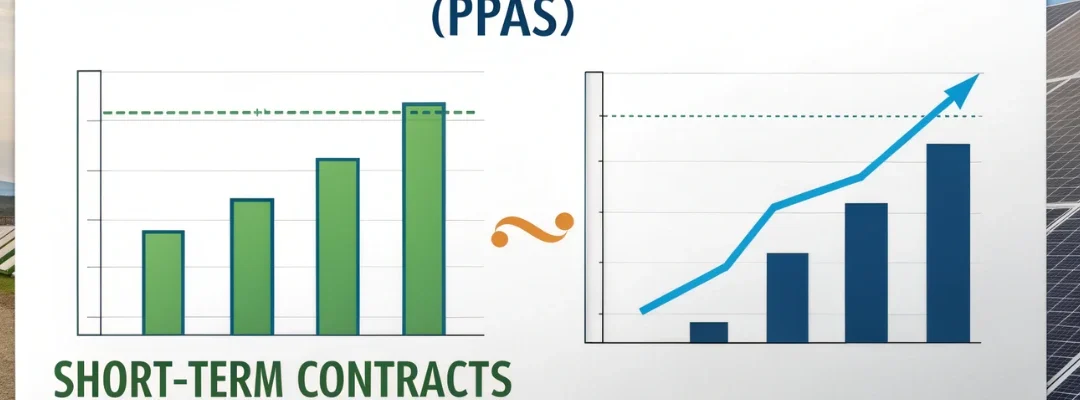
Head-to-Head Comparison: Long-Term vs. Short-Term Solar Agreements
Factor
Long-Term PPA (15–25 yrs)
Short-Term Contract (1–5 yrs)
Tariff Stability
High – Fixed for decades
Low – Prone to fluctuation
Flexibility
Low
High – Switch anytime
Financing & Bankability
Strong
Weak
Ideal Use Case
Large corporates, solar parks
SMEs, pilot solar users
Risk Exposure
Low
Medium to High
Setup Time
Longer (due diligence)
Faster
Real-World Case Studies
Tech Park in Bengaluru (Long-Term PPA)
20-year PPA at ₹4.5/unit
Grid tariffs rose to ₹8/unit
Annual savings: ₹12–15 crore
Enhanced sustainability ranking for global clients
Manufacturing SME in Gujarat (Short-Term Contract)
Chose 3-year PPA at ₹4.9/unit
Tariff renewal jumped to ₹6.3/unit after expiry
Net savings dropped by 40% in year four
Lesson: Long-term PPAs offer financial insulation and ESG alignment; short-term contracts provide flexibility but carry renewal risks.
When Should You Choose Which?
Choose Long-Term PPA If...
You have stable energy demand over the next 10–20 years
You want to secure funding and lower cost of capital
You have RE100 or sustainability reporting mandates
You want to lock in predictable OPEX
Choose Short-Term Contract If...
You’re just testing solar as a new strategy
Your operations may relocate, expand, or scale down
You want rapid deployment with minimal commitment
You’re in a policy-uncertain state or transitioning business model
The Future of Contract Models in Indian Solar
India’s maturing solar market is seeing:
Hybrid models (e.g. 5-year lock-ins with renewal clauses)
Greater adoption of open access and group captive PPAs
State-level policies encouraging longer tenure PPAs for grid stability
Corporate ESG mandates driving preference for long-term solar procurement
As regulations evolve and energy prices fluctuate, businesses that balance flexibility with foresight will benefit most.
Developing a solar park is not just about panels and power purchase agreements — it starts with land.
Solar projects need hundreds or even thousands of acres.
In India, this land is often fragmented, with multiple owners, unclear titles, and legal risks.
This is where land aggregators step in. They act as a bridge between landowners, developers, and investors, ensuring smooth land acquisition and project execution. In this blog, we’ll explain step-by-step how land aggregators work.
Step 1: Identifying Suitable Land
Aggregators scout for land in areas with high solar radiation, good grid connectivity, and stable soil conditions.
They check:
Proximity to substations and transmission lines
Flat terrain with minimal shadow
Land use regulations (non-forest, non-disputed agricultural land)
Only suitable, risk-free land is shortlisted.
Step 2: Engaging with Landowners
Most solar park land belongs to farmers or small landholders.
Aggregators:
Negotiate with each landowner.
Offer outright purchase or long-term lease models.
Ensure farmers get fair compensation or steady rental income.
This creates a win-win deal for both farmers and developers.
Step 3: Consolidating Land Parcels
Developers need large continuous blocks of land (100–500+ acres).
Aggregators consolidate multiple small plots into one large parcel.
They handle:
Boundary surveys
Plot demarcation
Legal mapping
The end result: a ready-to-use, contiguous land parcel for solar projects.
Step 4: Legal Due Diligence
Title checks, ownership verification, and clearance of disputes.
Verification of:
Encumbrances (mortgages/loans)
Land records and mutation status
Zoning compliance
This ensures the land is legally clean, giving confidence to developers and investors
Step 5: Structuring the Deal for Developers & Investors
Based on project type, land can be offered as:
Outright Sale → Developer owns the land.
Lease Agreement → Developer leases land for 25–30 years.
Joint Venture Models → Farmers or investors share revenue.
Aggregators design deals that reduce upfront burden for developers and give steady income to landowners.
Step 6: Facilitating Approvals & Grid Access
Support in getting:
Local authority NOCs
Conversion of agricultural land (if needed)
Transmission and grid connection approvals
Faster approvals mean fewer project delays.
Step 7: Handover to Developers & Investors
Once land is clean, consolidated, and approved → it is handed over to developers.
Investors benefit from:
Lower project risk
Faster project execution
Improved ROI
Example: How an Aggregator Simplified a Project
A developer needed 300 acres in Karnataka for a 60 MW solar park.
The land was owned by 120 farmers with small plots.
The aggregator negotiated with all owners, cleared disputes, and delivered a single consolidated parcel.
Result: The project was commissioned 8 months faster, saving crores in delays.