by trueimpactdigital | Oct 16, 2024 | Residential & Housing Societies
Introduction: A Smarter Way for Housing Societies to Save
In most Indian housing societies, electricity bills are one of the biggest monthly expenses. From running lifts and water pumps to lighting common areas, the costs quickly add up — often forming 40–50% of the maintenance fees residents pay.
The good news? Rooftop solar power can cut these costs almost in half, making societies more sustainable and financially independent.
Why Housing Societies Spend So Much on Power
- Lifts & Elevators – constant usage in multi-storey buildings
- Water Pumps – to supply overhead tanks
- Common Area Lighting – corridors, parking, gardens, security cabins
- Clubhouses & Amenities – gyms, swimming pools, halls
For a mid-sized society of 100 flats, monthly common area electricity bills can range from ₹50,000 to ₹1,50,000.
How Rooftop Solar Helps Cut Costs
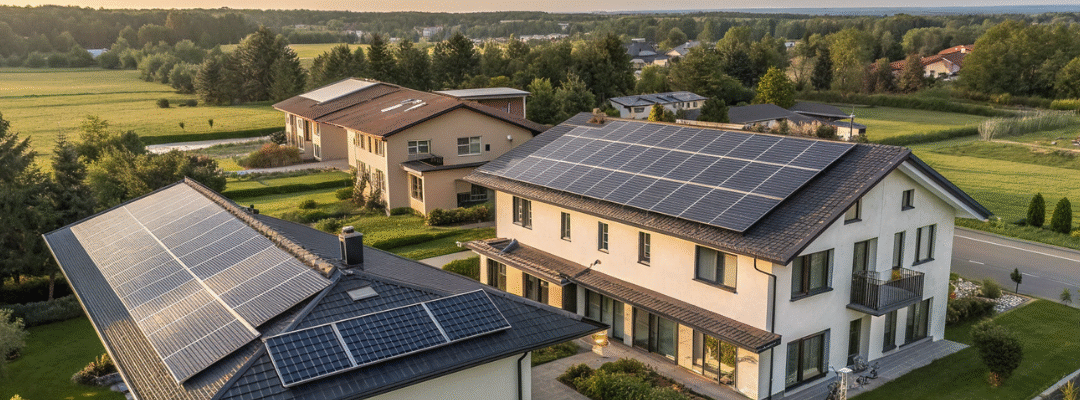
By installing a collective rooftop solar system, societies can:
- Generate free power during the day (when most usage is highest)
- Offset 40–50% of electricity costs within 3–5 years
- Use net metering to export surplus electricity and earn credits
- Lower monthly maintenance fees for every household
Example: Savings for a 100-Flat Society
- System Size: 50 kW
- Cost: ₹30–35 lakhs
- Subsidy (40% up to 10 kW + 20% for additional): ~₹8–10 lakhs
- Final Cost: ₹22–25 lakhs
- Monthly Bill Before Solar: ₹1,00,000
- Monthly Bill After Solar: ₹50,000–₹60,000
- Annual Savings: ₹5–6 lakhs
- Payback Period: ~4 years
- System Life: 25 years → ₹1.2+ crore savings over lifetime
Government Support & Subsidies
Under the Pradhan Mantri Surya Ghar Yojana and MNRE programs:
- Housing societies get capital subsidies for rooftop solar
- Easy net metering approval through DISCOMs
- Low-interest green loans available for RWAs and co-operatives
Note: Always use an MNRE-approved vendor to claim subsidies.
Extra Benefits for Societies
- Lower Maintenance Fees – residents pay less every month
- Higher Property Value – flats in “green” societies sell faster
- Eco-Friendly Branding – shows commitment to sustainability
- Resilience – battery-backed systems help during power cuts
- Community Impact – cleaner air, reduced carbon footprint
Each 1 kW of solar saves 1.2 tons of CO₂ per year — for a 50 kW society system, that’s 60 tons annually, equal to planting 2,500 trees!
Tips for Housing Societies
- Do an Energy Audit – check average monthly consumption
- Choose Tier-1 Panels & Branded Inverters – for durability
- Leverage Net Metering – to monetize extra power
- Sign AMC (Annual Maintenance Contracts) – ensures smooth operation
- Engage Residents Early – build support with clear cost-benefit sharing
Case Study: Bengaluru Housing Society
- Flats: 120
- System Size: 40 kW
- Savings: ₹4.5 lakhs per year
- Payback Period: 4.2 years
- Resident Feedback: Monthly maintenance dropped by ₹800 per flat
“Solar reduced our maintenance costs and gave us pride as a green community. Best decision we made as a society.” – RWA President
by trueimpactdigital | Oct 15, 2024 | Solar Maintenance & Efficiency
Introduction: Solar Is a Long-Term Investment
When you install rooftop solar, you’re not just buying panels — you’re investing in 25+ years of free, clean electricity. But here’s the catch: just like a car or any other machine, solar systems need regular care to perform at their best.
Proper maintenance is what ensures your promised savings actually last decades. Neglect it, and you could lose 20–30% of output (and the financial benefits along with it).
Why Maintenance Matters
1. Dust and Dirt Reduce Efficiency
- In India, dust, bird droppings, and pollution can block sunlight.
- Dirty panels can cut power generation by 10–20%.
2. Inverter is the Heart of the System
- Inverters convert solar power (DC) into usable electricity (AC).
- They usually last 8–12 years and need timely servicing or replacement.
3. Loose Connections and Wear & Tear
- Over years, wiring, mounting structures, and fuses can degrade.
- Small faults, if ignored, can cause major system downtime.
4. Battery (Optional) Needs Care
- Hybrid or off-grid systems with batteries need regular checks.
- Proper maintenance extends battery life from 5 to 10 years.
Maintenance = Maximum Savings
A well-maintained system ensures:
- Maximum generation → more savings on bills
- Longer lifespan → 25 years of free electricity
- Faster ROI → 3–5 years instead of 6–8 years
- Safety → reduces risk of short circuits or fire hazards
Example: A 5 kW system that should save ₹80,000 a year may drop to just ₹60,000 if panels aren’t cleaned. That’s a loss of ₹20,000/year — or ₹5 lakh over 25 years!
What Maintenance Involves
Basic Monthly Care (Society staff or homeowners)
- Clean panels with water (avoid hard brushes)
- Check for shade from new trees or structures
- Monitor output on inverter/mobile app
Annual Professional Service (AMC – Annual Maintenance Contract)
- Full inspection of panels and mounts
- Inverter software/firmware updates
- Wiring, fuse, and safety check
- Performance report
Cost of AMC: ₹3,000–₹5,000 per year for residential systems — tiny compared to annual savings of ₹50,000–₹80,000.
Why AMC (Annual Maintenance Contracts) Are Worth It
- Guaranteed uptime and performance
- Quick repair/replacement under warranty
- Peace of mind for homeowners and housing societies
- Ensures subsidy compliance (MNRE-approved vendors often require proof of maintenance)
Case Study: Delhi Homeowner
- System Size: 4 kW
- Initial Savings: ₹5,000/month
- After 2 years without cleaning: dropped to ₹3,800/month
- After AMC service: restored to ₹5,200/month
“We didn’t realize cleaning made such a big difference. Now we’ve signed a 5-year AMC to keep it running at full capacity,” says Mr. Mehra, Dwarka.
by trueimpactdigital | Oct 14, 2024 | India’s Solar Growth & Policy Challenges
Introduction: A Historic Opportunity for India
India’s rapidly growing economy needs enormous amounts of energy. For decades, this demand has been met by oil and coal, much of it imported. The result? High energy costs, trade deficits, and environmental damage.
But today, India stands at a transformational juncture. With:
- 300+ sunny days a year,
- falling solar costs, and
- supportive government policies,
solar energy can lead the way in replacing fossil fuels and ensuring true energy independence.
The Current Energy Picture: Heavy Dependence on Fossil Fuels
- Coal: Provides 70%+ of India’s electricity, but at high pollution and climate costs.
- Oil: India imports 85% of its crude oil, draining billions in foreign exchange.
- Environmental Impact: Burning coal and oil leads to severe air pollution and CO₂ emissions, contributing to health crises and climate challenges.
This dependence leaves India exposed to global price shocks and supply disruptions.
Why Solar Is the Key to Energy Independence
1. Abundant and Free Resource
- Sunlight is free, local, and renewable.
- India’s geography ensures reliable solar power year-round.
2. Rapidly Falling Costs
- Utility-scale solar tariffs: ₹2.0–₹2.5/kWh (cheaper than coal).
- Rooftop solar adoption is rising with subsidies and net metering.
- Battery storage costs are falling, enabling 24/7 renewable energy.
3. Strengthening Energy Security
- Less dependence on oil imports shields India from geopolitical risks.
- Local solar production = self-reliance (Atmanirbhar Bharat).
4. Environmental Benefits
- Every 1 MW of solar avoids 1,200–1,500 tons of CO₂/year.
- Helps India achieve its net zero by 2070 target.
How Solar Can Replace Coal & Oil (Sector by Sector)
Electricity Generation
- Retire old, inefficient coal plants.
- Replace them with utility-scale solar and hybrid projects (solar + wind + storage).
- Rooftop and community solar reduce transmission losses and bring clean power directly to homes.
Transportation
- Electric vehicles (EVs) powered by solar-generated electricity.
- Growth of solar-powered EV charging stations cuts oil imports.
Industrial & Commercial Energy
- Factories adopting captive solar power to reduce costs.
- Green hydrogen from solar can replace natural gas and oil-based fuels in heavy industries like steel and cement.
Government Initiatives Powering the Transition
- National Solar Mission → 500 GW renewable target by 2030.
- Pradhan Mantri Surya Ghar Yojana → Subsidies for rooftop solar in homes.
- PLI Schemes → Boosting domestic solar panel and inverter manufacturing.
- National Green Hydrogen Mission → Using solar to create clean fuels.
Economic & Social Benefits of Solar-Led Independence
- Lower Power Costs → Affordable electricity for households and industries.
- Job Creation → Solar industry to create lakhs of jobs in manufacturing, installation, and maintenance.
- Better Public Health → Cleaner air reduces healthcare costs.
- Stronger Economy → Cutting oil/coal imports reduces the trade deficit.
Challenges to Overcome
- Grid Modernization → Upgrade infrastructure to handle renewable variability.
- Energy Storage → Scale up batteries and pumped-hydro solutions.
- Stable Policies → Consistent regulations build investor confidence.
- Financing & Awareness → Simplify rooftop solar loans and educate consumers.
Expert Insight
“India doesn’t need to wait decades to be energy independent. With solar, the shift can happen this decade — cutting imports, lowering bills, and cleaning the air.”
— Dr. Meera Patel, Energy Policy Advisor
by trueimpactdigital | Oct 13, 2024 | Residential & Housing Societies
Introduction: Investing Smartly in Solar
Rooftop solar is one of the smartest investments Indian homeowners and housing societies can make. It can slash electricity bills, provide energy independence, and increase property value.
But to get the best performance and safest return, you need to evaluate a few critical factors before installation. This simple guide explains what you should check before going solar.
1. Assess Your Energy Needs
- Review your last 12 months’ electricity bills.
- Average monthly consumption helps size your system (3 kW, 5 kW, etc.).
- Consider peak load appliances like ACs, geysers, and washing machines.
Sizing correctly ensures you don’t under- or over-invest.
2. Roof Space and Strength
- Space needed: ~100 sq. ft. per 1 kW of solar panels.
- Roof structure: Must support panel weight and mounting frames.
- Orientation: South-facing with the right tilt (equal to your latitude) gives maximum output.
- Avoid shadows from nearby trees/buildings.
3. Local Rules & Net Metering Policies
- Check DISCOM policies in your state — rules differ for system size and approvals.
- Ensure your installer helps with subsidy applications and net-metering paperwork.
- Under the Pradhan Mantri Surya Ghar Yojana, homeowners can get up to 40% subsidy on rooftop systems.
4. Choose Quality Components
- Panels: Go for Tier-1, MNRE-approved monocrystalline or bifacial panels with a 25-year performance warranty.
- Inverters: Pick a trusted brand. String inverters are common; microinverters are better for partially shaded rooftops.
- Balance of System: High-quality cables, mounting structures, surge protection, and proper earthing ensure safety.
5. Select a Certified, Experienced Installer
- Always hire an MNRE-approved EPC contractor.
- Ask for references or visit past installations.
- Ensure they cover design, installation, subsidy, net-metering, and maintenance.
- Check if they offer an Annual Maintenance Contract (AMC) for long-term support.
6. Estimate Cost, Savings & Payback
- Get multiple quotes with a clear breakdown of panels, inverter, wiring, labor, and approvals.
- Typical ROI is 3–5 years after subsidy.
- Ask for a generation estimate report (units per year + projected savings).
Example: A 5 kW system costing ₹2.4 lakh (₹1.6 lakh after subsidy) can save ₹70,000–₹80,000 per year, paying for itself in ~3 years.
7. Know the Maintenance Needs
Solar is low-maintenance but not zero-maintenance:
- Clean panels every 2–4 weeks to remove dust.
- Monitor output using the inverter app.
- Get annual inspections to check wiring, earthing, and panel health.
8. Safety & Warranty Coverage
- Ensure your installer follows safety standards: earthing, surge protection, lightning arrestors.
- Warranties to check:
- Panels → 10–12 years product + 25 years performance
- Inverters → 5–10 years (depending on brand)
- Confirm after-sales support response time before signing.
by trueimpactdigital | Oct 12, 2024 | Solar Economics & ROI
Introduction: Solar as a Middle-Class Solution
For most middle-class Indian families, rising electricity bills are a major monthly expense. With power tariffs increasing every year, households paying ₹3,000–₹8,000 per month on electricity are looking for long-term savings and energy independence.
Rooftop solar has emerged as one of the smartest financial decisions. Thanks to government subsidies, falling equipment costs, and shorter payback periods, solar is no longer just an eco-friendly choice — it’s an economic necessity.
How Much Does Solar Cost for a Home?
As of 2025:
- System Cost (before subsidy): ₹45,000–₹55,000 per kW
- Government Subsidy (PM Surya Ghar Yojana):
- 40% for up to 3 kW
- 20% for 4–10 kW
- Effective Cost (after subsidy): ₹30,000–₹35,000 per kW
Example:
- A 5 kW system → Gross ₹2.4–₹2.7 lakh → Net Cost ₹1.5–₹1.7 lakh (after subsidy).
Typical Middle-Class Consumption and Solar Sizing
- 2–3 BHK flat / small independent house: ~3–5 kW system
- Electricity Bill: ₹3,500–₹7,000/month
- Savings: 70–100% reduction in monthly bills
A 4 kW rooftop system can generate 500–600 units/month, enough to power lights, fans, refrigerators, TVs, laptops, and a couple of ACs.
The Payback Period
- Payback time (after subsidy): 3–5 years
- System life: 25 years
- Annual Savings: ₹50,000–₹80,000
- Lifetime Savings: ₹10–15 lakhs per household
That means after the initial payback, families enjoy two decades of nearly free electricity.
Financing Options for Middle-Class Families
The government and banks are making solar more accessible:
- Green Home Loans: Reduced interest rates for solar adoption (SBI, HDFC, Bank of Baroda).
- EMI Options: Monthly installments can be as low as your current electricity bill.
- Direct Benefit Transfer (DBT): Subsidy credited straight into your bank account.
Beyond Money: Environmental & Lifestyle Benefits
- Each 1 kW of solar = saves 1.2 tons of CO₂ per year (like planting 50 trees).
- Protection from rising power tariffs.
- Higher property value – solar homes sell faster and at better prices.
- Independence during power cuts (with optional battery backup).
Case Example: A Middle-Class Family in Lucknow
- Family Size: 4 members in a 3 BHK
- Electricity Bill Before Solar: ~₹6,000/month
- System Installed: 4 kW rooftop solar
- Investment (after subsidy): ₹1.4 lakh
- New Monthly Bill: ₹200–₹300
- Payback Period: 3.8 years
- Lifetime Savings: ~₹12 lakh
“We treated solar as an investment, like an FD. But unlike an FD, it saves us money every month and protects us from rising bills,” says Mr. Sharma, homeowner.
Key Considerations for Families
- Ensure shadow-free roof space (90–100 sq. ft. per kW).
- Work with MNRE-approved installers to claim subsidies.
- Opt for Tier-1 panels (Tata, Vikram, Adani, Waaree).
- Check for net metering availability in your state.
- Sign an AMC (Annual Maintenance Contract) for long-term efficiency.