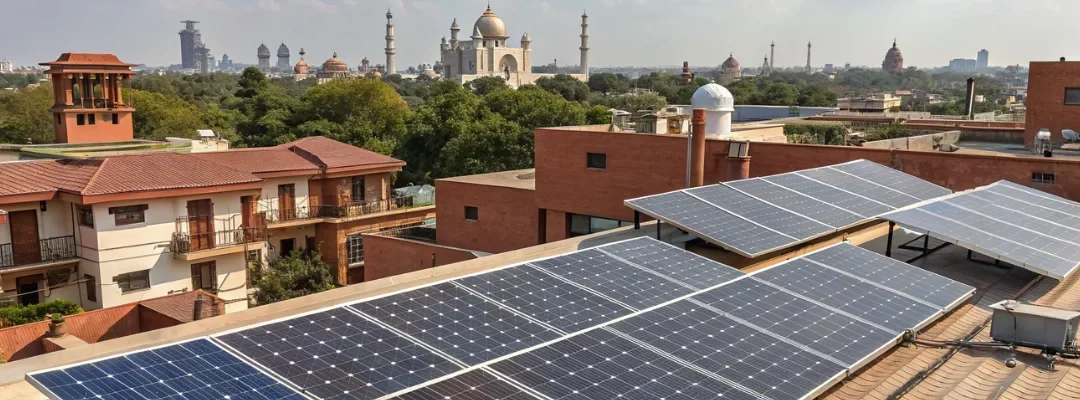
India is the world’s third-largest energy consumer, but it relies heavily on imported fossil fuels to meet its needs. Nearly 85% of crude oil and 25% of coal used in India are imported, costing billions of dollars annually and exposing the country to global price volatility.
To secure its future, India must reduce dependence on fossil fuels and invest in homegrown, renewable power. And among all clean energy sources, solar is India’s best bet for achieving true energy independence.
Why Solar Outshines Other Options
1. Abundant and Free Resource
India enjoys 300+ sunny days per year.
The country receives 5,000 trillion kWh of solar radiation annually — far more than its total energy demand.
Unlike coal and oil, sunlight is free, unlimited, and domestic.
2. Falling Costs Make Solar the Cheapest Energy
Solar tariffs have dropped to ₹2.0–₹2.5 per kWh, cheaper than new coal plants (₹4–₹6 per kWh).
Local manufacturing and global competition continue to drive costs down.
For households, rooftop solar now pays back in just 3–5 years.
3. Strengthening Energy Security
Solar reduces reliance on imports, insulating India from oil shocks and global fuel price volatility.
Domestic solar manufacturing (boosted by PLI schemes) keeps the value chain within India.
4. Environmental & Health Benefits
Every 1 MW of solar installed avoids 1,200–1,500 tons of CO₂ annually.
Reduced coal burning means cleaner air, lower healthcare costs, and healthier cities.
Solar vs Other Energy Sources
Energy Source
Import Dependency
Cost per Unit (₹)
Environmental Impact
Scalability in India
Coal
25% (imports)
4.5–6.0
High CO₂ + pollution
Limited land, supply
Oil
85% (imports)
8–12
Very high emissions
Transport only
Natural Gas
50% (imports)
5–7
Moderate CO₂
Limited reserves
Solar
0% (domestic)
2–2.5
Zero emissions
Abundant rooftop + land potential
Solar is cheaper, cleaner, and fully domestic.
overnment Push for Solar Independence
Pradhan Mantri Surya Ghar: Muft Bijli Yojana → Subsidies for rooftop solar in 1 crore homes by 2027.
National Solar Mission → Scaling solar parks and rooftop capacity to help India meet its 500 GW renewable target by 2030.
PLI Schemes → Incentives for domestic manufacturing of panels, batteries, and inverters.
Green Hydrogen Mission → Solar-powered hydrogen production to decarbonize heavy industries.
Solar for Every Sector
Households → Rooftop solar slashes electricity bills by 70–100%.
Housing Societies → Common area loads powered by solar cut maintenance fees by 40–50%.
Businesses & Factories → Captive solar power lowers costs and boosts competitiveness.
Transport → Solar-powered EV charging reduces oil dependence.
Rural India → Solar microgrids electrify villages, reducing reliance on diesel generators.
Expert Insight
“Solar is more than an energy source — it’s India’s insurance policy against global fuel shocks. With abundant sunshine and falling costs, India has a once-in-a-lifetime opportunity to achieve energy independence through solar.” — Dr. Meera Patel, Energy Policy Advisor
India is racing to become a global clean energy leader with a target of 500 GW of renewable energy by 2030, and solar is expected to do most of the heavy lifting. While financing and technology have advanced rapidly, a less discussed bottleneck often slows projects before they even start: land acquisition and regulatory approvals. From converting agricultural land to non-agricultural use, to navigating multiple state-level permissions, these processes can add months—sometimes years—to project timelines. Understanding why this happens is critical to removing barriers and unlocking India’s full solar potential.
Why Land Matters So Much in Solar Development
Utility-scale solar parks and even some community solar projects require vast tracts of land:
1 MW of solar needs 4–5 acres of shadow-free land.
The land must be accessible to transmission infrastructure.
Developers often need contiguous parcels with clear titles.
Without timely access to appropriate land, projects remain stuck on paper.
Key Land-Related Challenges Slowing Projects
1. Agricultural to Non-Agricultural (NA) Conversion
Most suitable solar land is classified as agricultural.
Converting it to NA involves multiple permissions from state revenue departments and local authorities.
Procedures and documentation vary drastically across states; some require clearances from 4–6 different departments.
2. Unclear Land Titles and Disputes
Lack of updated land records and digitization leads to disputes and due-diligence delays.
Inconsistent mutation records make it difficult for developers to verify legal ownership.
3. State-Specific Policy Inconsistencies
Some states provide single-window clearances, while others have fragmented processes.
Different stamp duty, registration fees, and NA conversion charges add to costs and confusion.
4. Environmental and Zoning Approvals
If land falls in ecologically sensitive zones or near forest areas, additional environmental clearances are needed.
Lack of clarity on zoning regulations sometimes leads to retroactive disputes and litigation.
5. Transmission and Right-of-Way (RoW) Delays
Even after land conversion, approvals for laying transmission lines or getting right-of-way through adjoining parcels can hold up commissioning.
Impact on India’s Solar Targets
These land bottlenecks have multiple downstream effects:
Delays of 6–24 months, leading to cost overruns.
Investor hesitation, as regulatory uncertainty raises project risk.
Under-utilization of central schemes like solar parks when land acquisition lags.
Tariff impact, as delays and higher transaction costs push up bid prices.
Best Practices & Successful Models
Gujarat & Rajasthan: Pre-acquired land and plug-and-play solar parks with ready NA status have reduced timelines.
Digitized Land Records: States with modern land records systems (like Karnataka’s Bhoomi portal) speed up title verification.
Single-Window Clearance Systems: Rajasthan’s RREC and similar nodal agencies act as one-stop approval shops.
How India Can Reduce Land-Related Delays
1. Standardize and Digitize Land Records Nationwide
Implement GIS-based mapping and e-records for faster title verification.
Encourage blockchain pilots for tamper-proof ownership records.
2. Create Central Guidelines for NA Conversion
Uniform timelines and documentation requirements across states.
Presumptive NA status for designated renewable energy zones.
3. Set Up Renewable Energy Land Banks
States can earmark and pre-convert land for solar and wind projects, reducing uncertainty for developers.
4. Simplify Environmental and RoW Approvals
Clear zoning regulations to avoid post-hoc disputes.
Fast-track RoW permissions for critical transmission corridors.
5. Strengthen Single-Window Mechanisms
Expand single-window models beyond leading states; integrate online tracking of application status.
When solar panels first appeared on rooftops in India two decades ago, they were expensive, bulky, and delivered modest efficiency. Fast forward to 2025, and solar is now the cheapest source of new power in the country.
But the story doesn’t stop here. Solar technology is evolving rapidly — from the polysilicon panels that dominate today, to emerging materials like perovskite, which promise higher efficiency at lower costs. The next chapter of India’s clean energy growth may well depend on how quickly these innovations scale.
The Era of Polysilicon: Today’s Workhorse
Most solar modules today use crystalline silicon wafers, made from refined polysilicon. They dominate because they are:
Proven and reliable, with 25+ year lifespans.
Mass-manufactured at scale, driving prices down.
Continuously improving, with efficiencies now reaching 20–23%.
India’s domestic manufacturing push under PLI schemes is largely focused on this technology, ensuring supply chains for polysilicon → wafers → cells → modules.
Yet, silicon has limitations — energy-intensive production, rigid form factors, and efficiency ceilings. This is where next-gen materials come in.
The Next Frontier: Perovskites
Perovskites are a new class of materials that can absorb sunlight more efficiently than silicon. What makes them exciting?
Efficiency potential → Lab tests show >30% efficiency when paired with silicon (tandem cells).
Lightweight & flexible → Can be coated onto glass, plastic, or even fabrics.
Cheaper to produce → Manufactured at lower temperatures, reducing energy use.
For India, perovskites could enable cheaper rooftop panels, solar windows, and even building-integrated photovoltaics (BIPV).
The catch? Stability. Perovskite cells degrade faster when exposed to heat and moisture — a big challenge in Indian conditions. Global R&D is racing to solve this.
Other Emerging Solar Technologies
The solar world isn’t betting on one horse. Alongside perovskite, several innovations are in the pipeline:
Bifacial Panels → Generate electricity from both sides, capturing reflected sunlight.
Thin-Film Solar → Lightweight, flexible modules for rooftops with limited load capacity.
Quantum Dot Solar → Nanomaterials engineered for high-efficiency light absorption.
Solar Paints & Coatings → Early-stage concepts where buildings can be coated with solar-active layers.
What This Means for India
India’s solar journey has so far been about cost reduction and scaling silicon. But in the coming decade, innovation will play a bigger role:
Domestic R&D Hubs → India needs to invest in perovskite and tandem research to adapt them to hot, humid conditions.
Flexible Solar Applications → Lightweight and building-integrated tech could revolutionize urban solar adoption.
Export Leadership → If India cracks perovskite stability, it could become a global supplier of next-gen modules.
Expert View
“The silicon era made solar cheap. The perovskite era could make solar limitless — powering not just rooftops and farms, but every surface exposed to sunlight.” — Dr. Meera Patel, Solar Materials Scientist
India has pledged 500 GW of non-fossil capacity by 2030, with solar expected to contribute over half of this target. But today, India depends heavily on imports of PV cells, wafers, modules, and critical raw materials, leaving the sector vulnerable to global price fluctuations and supply disruptions.
To achieve true energy independence, India must build a self-reliant solar supply chain that spans manufacturing, R&D, raw materials, and exports.
India’s Current Solar Supply Chain Landscape
Imports Dominate → India imports the bulk of cells and modules, mostly from China and Southeast Asia.
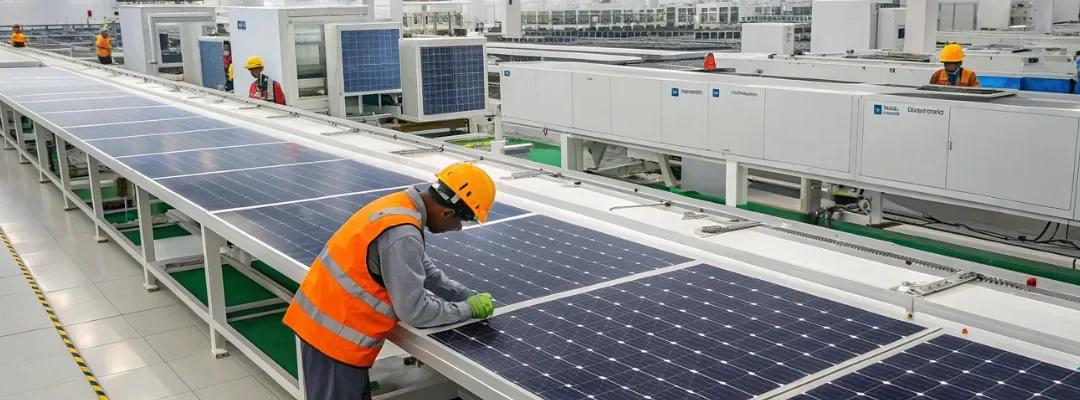
Limited Domestic Capacity → Module manufacturing has grown (~40+ GW), but cell and wafer production is still limited.
Raw Material Gaps → Polysilicon, EVA sheets, and solar-grade glass are largely imported.
Surging Demand → With rooftop + utility-scale projects booming, India needs a reliable and affordable supply of components.
Key Challenges Hindering Self-Reliance
High Capital Costs → Building polysilicon and cell facilities requires billions in investment.
Technology Gaps → India lags in advanced PV technologies like TOPCon and HJT.
Fragmented Supply Chain → Lack of integration between wafer → cell → module → inverter → storage.
Skilled Workforce Shortage → Need for technicians trained in advanced solar manufacturing.
China → Built integrated clusters for polysilicon, wafers, cells, and modules backed by large-scale R&D.
United States → The Inflation Reduction Act provides tax credits and manufacturing incentives.
European Union → The EU Green Deal emphasizes local supply chains and recycling.
India can blend these lessons with its unique strengths — abundant demand, skilled labor, and strong policy momentum.
Expert Insight
“India must not miss the solar manufacturing revolution. By investing in the entire value chain — from raw materials to exports — we can turn solar into both an energy and economic powerhouse.” — Dr. Ramesh Iyer, Solar Manufacturing Specialist
India has committed to 500 GW of non-fossil fuel energy capacity by 2030, with solar expected to contribute nearly 280–300 GW. While the central government has laid out strong frameworks and subsidy schemes, the real implementation lies with states.
Unfortunately, policy inconsistencies at the state level — especially around rooftop and distributed solar — are slowing progress. To unlock India’s full solar potential, we need to understand where these gaps exist.
Why State-Level Policies Matter for Solar Adoption
Electricity in India is a concurrent subject — both the Centre and states share responsibility.
The Ministry of New and Renewable Energy (MNRE) sets national policies and subsidies.
But states control the critical details, including:
Net metering approvals
Tariff structures for exported solar power
Grid connectivity timelines
Open access rules for industries
The result is a patchwork of regulations, where what works in Gujarat or Karnataka may not work in Uttar Pradesh or Bihar — creating uncertainty for both consumers and investors.
Key Policy Inconsistencies Slowing Growth
1. Net Metering Caps and Restrictions
Some states cap rooftop systems at 10 kW for homes or 1 MW for industries.
DISCOMs often delay or deny approvals, citing technical limits.
Settlement periods differ — monthly in some states, yearly in others — changing payback economics.
2. Tariff Variations and Unpredictability
Surplus solar export tariffs vary widely (₹2.25/kWh in some states vs ₹4/kWh in others).
Sudden retroactive cuts in tariffs have led to legal disputes and financial losses.
3. Open Access and Wheeling Charges
C&I (commercial & industrial) projects face cross-subsidy surcharges, wheeling charges, and banking charges that differ by state.
Some states restrict banking periods to 15–30 days, reducing project viability.
4. Delays in Approvals and Grid Connectivity
Cumbersome paperwork and manual processes slow rooftop adoption.
Lack of digital integration increases uncertainty for developers.
5. Lack of Uniform Subsidy Implementation
Central subsidies under Pradhan Mantri Surya Ghar: Muft Bijli Yojana are often delayed at the state DISCOM level.
Few states offer additional incentives, limiting uptake among residential consumers.
Impact of Policy Fragmentation
Rooftop Solar Lag → Less than 20% of India’s solar capacity comes from rooftops, far behind the target.
Investor Hesitation → Developers avoid states with unpredictable or changing policies.
Higher Costs for Consumers → Lack of scale keeps solar prices higher in restrictive states.
Slower Industrial Adoption → C&I users — who could benefit the most — are discouraged by extra surcharges.
What Can Be Done to Harmonize Policies?
1. Central Guidelines with Minimum Standards
MNRE should enforce uniform net metering, open access, and tariff benchmarks across all states.
2. Digitalization of Processes
Expand national-level portals (like the rooftop solar portal) to all states for faster, transparent approvals.
3. Stable, Long-Term Tariff Policies
States must provide predictable, fixed-term export tariffs and avoid retroactive changes.
4. Standardized Banking & Wheeling Rules
A common framework for banking duration and wheeling charges would make C&I solar more attractive nationwide.
5. Capacity Building for DISCOMs
Train and incentivize DISCOMs to:
Process applications efficiently
Integrate rooftop solar smoothly
View solar as a partner for grid stability, not a competitor.
Expert Insight
“Solar adoption is slowed less by technology or financing, and more by uncertainty. A stable, uniform regulatory framework will do more for solar adoption than any subsidy.” — Dr. Ramesh Iyer, Energy Policy Expert