India is entering a golden era of solar energy. With 300+ sunny days a year, falling solar panel prices, and government initiatives like PM-KUSUM and net metering, it's never been easier — or smarter — to earn passive income by harnessing sunlight.
Whether you have a rooftop, farmland, or some investment capital, there’s a solar business model that suits your lifestyle and offers long-term, hands-free returns.
Here are eight powerful ways to turn solar energy into reliable income in 2026.
1. Lease Your Land for Solar Power Projects
Own underused land? You can lease it to solar developers who will install solar farms and pay you fixed rent for 20–25 years.
How It Works:
You sign a long-term lease with a solar EPC (Engineering, Procurement, Construction) company.
They handle permits, installation, and operations.
You earn passive rent — no maintenance required.
Potential Income:
₹30,000–₹1,00,000 per acre per year (depends on location and grid connectivity).
Why It’s Great:
Zero upfront cost
Stable, inflation-proof income
Land remains yours
2. Rooftop Solar + Net Metering: Earn & Save Monthly
Have a rooftop? Use it to slash your electricity bill and earn money by selling extra power to the grid via net metering.
Quick Facts:
A 5kW system can save ₹6,000–₹8,000/month
Govt. subsidies cover up to 40% of installation cost
Payback period: 4–5 years
Best for: Homeowners, small businesses, and housing societies.
Pro tip: Use solar calculators to estimate your savings and ROI before installing.
3. PM-KUSUM Scheme: Solar Income for Farmers
The PM-KUSUM scheme empowers Indian farmers to set up decentralized solar power plants.
Options:
Install solar pumps for irrigation.
Build small solar plants (0.5–2 MW) on farmland.
Sell unused power to DISCOMs at fixed feed-in tariffs.
Potential Return: ₹1–₹2 lakh per acre annually Bonus: Dual-use of land (solar + agriculture = agrivoltaics)
Learn more: MNRE's PM-KUSUM Page
4. Join a Solar Co-Investment or Community Project
Don’t have a rooftop or land? No problem. Invest in community solar parks or shared solar farms.
How it Works:
Pool funds with others to fund a solar plant.
Receive profit share from electricity sales (PPA or grid supply).
Best for: NRIs, climate-conscious investors, and passive income seekers.
5. Set Up a Solar-Powered EV Charging Station
With EV adoption rising fast, solar-powered charging stations are becoming highly lucrative.
Own a warehouse, factory, or office building with unused roof space? Monetize it by signing a Power Purchase Agreement (PPA) with a solar company.
Key Benefits:
You get rental income or revenue share
No capital expenditure required
Boosts your ESG/sustainability profile
Example: A 100kW rooftop system can generate ₹10–₹15 lakh/year in power value.
7. Lease Solar Equipment to EPC Companies
If you have funds but no space, invest in solar hardware (panels, batteries, inverters) and lease them to EPCs or solar startups.
Why This Works:
Fixed lease income
Asset-based investment with rising demand
Works well in areas where capital is needed but infrastructure is limited
Tip: Work with verified EPCs or energy startups to reduce risk.
8. Solar-Powered Water & Irrigation Solutions
Demand is booming for solar irrigation pumps, especially in water-scarce rural India.
Business Model:
Offer solar pump systems on rent or pay-per-use to nearby farmers.
Use government subsidies (MNRE & state-level) to reduce setup cost.
Best For: Agri-entrepreneurs, cooperatives, or farm equipment renters.
Why Solar is the #1 Passive Income Source for 2026
Predictable ROI: Solar panels last 20–26 years Low Maintenance: Minimal ongoing costs Government Support: Strong incentives & policies Eco-Friendly: Earn while reducing carbon emissions Scalable: Start small, grow over time
Solar energy isn’t just transforming how India powers its homes — it’s also creating smart financial opportunities for individuals and investors. Today, you don’t need to be an industrial developer to make money from solar — you can start small, invest wisely, and generate passive income from solar energy in India with minimal effort.
Here are the top 5 proven ways to earn solar income while contributing to India’s clean energy mission.
1. Rooftop Solar Systems – Save and Earn via Net Metering
A rooftop solar plant is the easiest way to earn passive income from solar energy right from your home or office. When your panels produce more electricity than you consume, the surplus is sent to the grid under India’s net metering system.
Instead of direct payment, you receive energy credits that reduce your monthly bills. At the end of the financial year (April–March), these credits are adjusted by your electricity board.
Example: A 10 kW solar system can generate about 12,000–14,000 units/year, saving around ₹8,000–₹12,000/month depending on your electricity tariff.
Why it’s passive: Once installed, it runs automatically for 20–25 years with minimal maintenance.
2. Community Solar Projects – Earn Without Owning a Roof or Land
If you don’t have land or roof space, you can still earn passive income from solar projects through community or shared solar investments.
These are large solar farms where multiple individuals invest small amounts. The power generated is sold to industries or utilities through long-term PPAs (Power Purchase Agreements).
Typical Returns: 8–12% per annum, depending on project tariff and location.
Why it’s passive: You don’t handle construction, operation, or maintenance — the developer does everything, and you receive your share of revenue.
3. Agri-Voltaics – Dual Income for Farmers
For farmers and rural landowners, agri-voltaic systems offer the best of both worlds — solar power and farming together. Solar panels are mounted high enough to let sunlight reach the crops below, creating a hybrid setup that supports both food and energy production.
Income Potential: Farmers earn from both crop sales and solar energy generation under PPA or developer partnership models.
Why it’s passive: The solar plant is managed by a professional EPC or developer, while farming continues normally.
4. Solar Funds & Green Bonds – Hands-Free Investment Returns
For investors who want passive income from solar power without owning or managing plants, solar funds and green bonds are smart choices.
These financial instruments pool investor money to fund multiple solar projects. In return, investors receive annual fixed returns — usually between 8% and 12%, depending on the portfolio’s performance.
Why it’s passive: No operational involvement. Your money finances renewable projects, and you earn from their power sales.
Why it’s not “fixed income”: It’s still linked to solar project performance and portfolio returns — not a contractual rent like leasing.
5. Solar Cooperatives & Local Energy Partnerships
An emerging opportunity in India is the formation of solar cooperatives — groups of farmers, residents, or small businesses that jointly invest in solar power plants.
These cooperatives sell power to DISCOMs or local industries under group PPAs, sharing profits among members.
Average Returns: 8–10% annually after operational costs, depending on the tariff and capacity.
Why it’s passive: Once the system is operational, management is handled by the cooperative board or partner developer.
Summary – Which Solar Passive Income Model Suits You Best?
Model
Ideal For
Returns
Effort
Rooftop Solar
Homeowners
₹8k–₹12k/month (bill savings)
Low
Community Solar
Small Investors
8–12%/year
Very Low
Agri-Voltaics
Farmers
Dual crop + solar income
Moderate
Solar Funds & Bonds
Investors
8–12%/year
None
Solar Cooperatives
Groups / Rural Clusters
8–10%/year
Low
Why Choose Synergy Solar Solution
At Synergy Solar Solution, we simplify the process of turning sunlight into a dependable source of income. From rooftop and community projects to agri-voltaics and EPC services, our end-to-end support ensures you enjoy steady, secure solar earnings.
10+ years of EPC and project management expertise.
Reliable partnerships with industrial and institutional power buyers.
Transparent ROI models and regulatory compliance.
Proven track record in solar projects across Tamil Nadu and India.
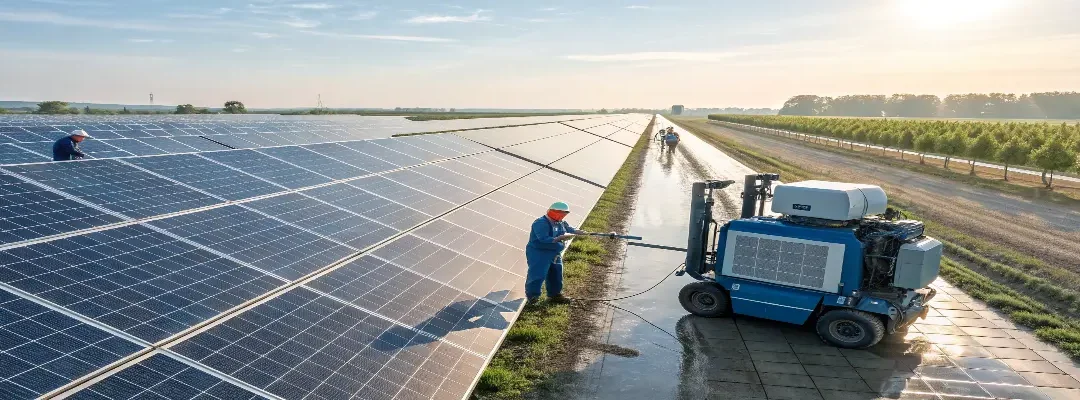
Solar energy is one of the fastest-growing renewable power sources, but its efficiency depends on keeping panels clean. Dust, pollen, sand, and bird droppings can lower efficiency by 10–30%, directly affecting ROI.
Traditional cleaning methods — manual washing, tractor-mounted brushes — require high labor, water, and time. In contrast, AI-powered and autonomous cleaning machines represent a game-changing solution. They use robotics, artificial intelligence, IoT sensors, and automation to clean panels smarter, faster, and more sustainably.
What Are AI-Powered Solar Cleaning Machines?
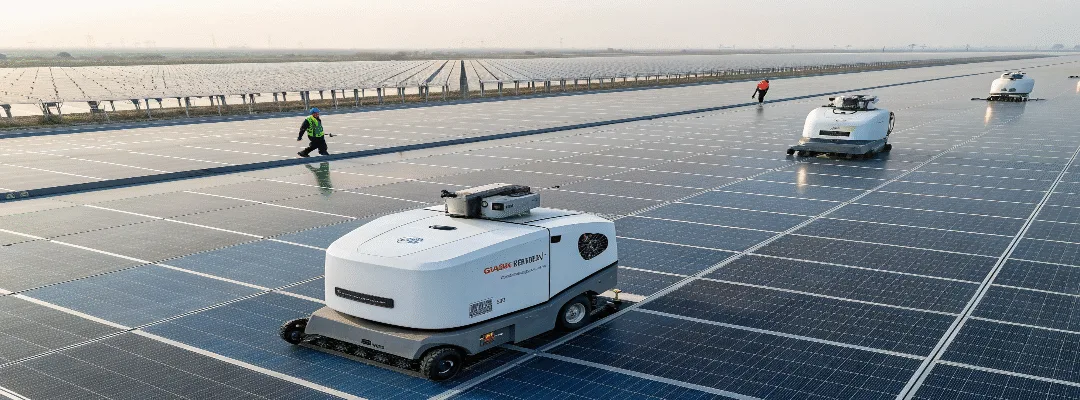
AI-powered solar cleaning machines are intelligent robotic systems that perform panel cleaning without human involvement. They are equipped with:
Onboard sensors to detect dust and debris.
AI-driven algorithms to optimize cleaning frequency.
Autonomous navigation to cover entire solar fields.
IoT connectivity for remote monitoring.
In short, they’re like a Roomba for solar farms — but designed for megawatt-scale efficiency.
Key Features and Science Behind AI Cleaning Systems
1. Autonomous Mobility
Robots use rail systems, wheels, or tracks to travel across solar arrays.
AI maps the farm and calculates shortest, most efficient routes.
Some models use vision-based navigation to avoid collisions.
2. Waterless Cleaning
Equipped with microfiber rollers, brushes, or air jets.
Saves 7,000–10,000 liters of water per MW per cleaning cycle.
Reduces both costs and environmental footprint.
3. Smart Cleaning Frequency
AI analyses soiling patterns, weather forecasts, and humidity levels.
Instead of cleaning daily, it cleans only when efficiency loss crosses 3–5%.
Extends panel life by avoiding over-cleaning.
4. Self-Powered Operation
Many robots recharge using small onboard solar panels.
Minimal electricity requirement → highly energy efficient.
5. IoT & SCADA Integration
Data syncs with the plant’s SCADA system.
Operators can track cleaning schedules, performance, and panel yield remotely.
Real-World Benefits
Improved Energy Yield
Keeps panels consistently clean, preventing energy dips.
Solar farms report 8–15% more annual generation after adopting autonomous cleaners.
Reduced O&M Expenses
Saves crores in labor and water costs every year.
Requires just 1–2 operators for oversight instead of 100+ workers.
Longer Panel Life
Brushes are engineered with softness < glass hardness.
Prevents micro-scratches and degradation.
Sustainability Impact
Reduces dependence on scarce water.
Lowers carbon footprint by automating a resource-heavy process.
Large solar farms often span hundreds of acres, with thousands of panels lined up in rows. Keeping them dust-free is a challenge. While robotic cleaners are popular, many utility-scale operators in rural regions rely on tractor-mounted solar panel cleaning systems.
But are these tractors really cost-effective? Let’s explore how they work, the savings they bring, and whether they’re worth the investment.
What Are Solar Panel Cleaning Tractors?
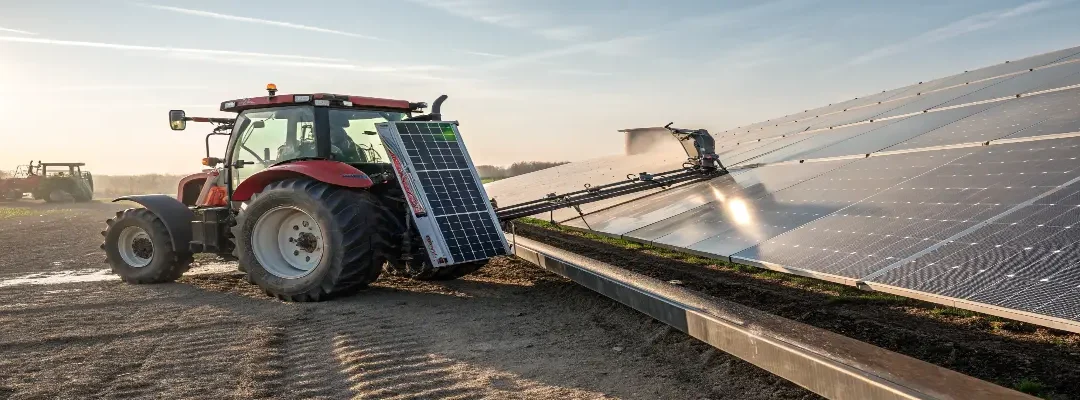
Solar panel cleaning tractors are modified agricultural tractors fitted with:
Long rotating brushes (up to 6–8 meters wide)
Hydraulic arms for easy reach
Water-assisted or waterless cleaning options
They move along solar panel rows, cleaning hundreds of panels in a single run.
Why Tractors for Solar Cleaning?
Designed for Scale – Clean large solar farms (10 MW–500 MW) quickly.
Solar farms spread across hundreds of acres generate megawatts of power daily. But dust, sand, and pollution can reduce output by 10–30%, costing operators crores in lost revenue.
The solution? Solar panel cleaning machines — from robotic cleaners to tractor-mounted systems — that keep panels dust-free, reduce operating costs, and maximize ROI for large-scale solar farms.
The Cost of Dirty Panels in Solar Farms
Dust accumulation reduces efficiency, leading to lower power generation.
A 100 MW solar farm can lose over ₹15–20 crore annually if panels are not cleaned regularly.
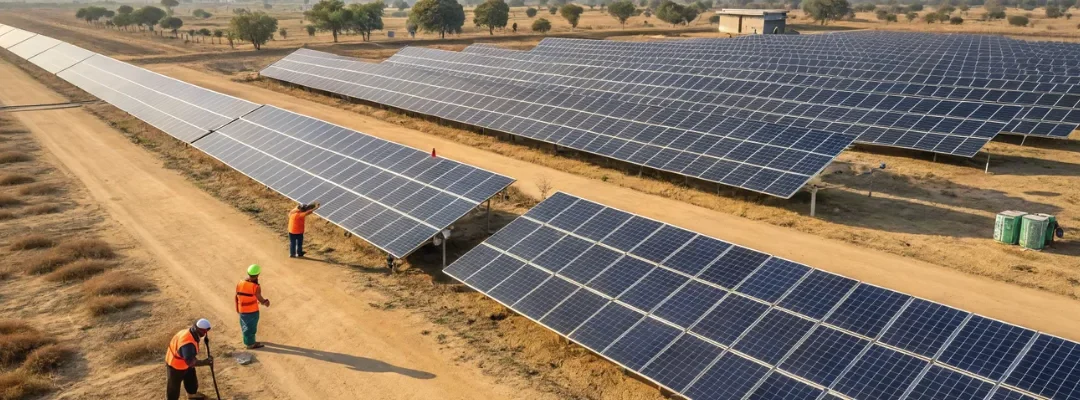
Manual cleaning requires water tankers, labor, and time, which increases O&M costs.
How Cleaning Machines Save Money
1. Higher Energy Output = More Revenue
Regular machine cleaning restores 10–15% more power generation.
Example: For a 50 MW farm, even a 10% gain equals ₹5–7 crore extra revenue annually.
2. Reduced Water Costs
Manual cleaning of 1 MW needs 7,000–10,000 liters of water.
Robotic waterless machines save millions of liters every year.
This reduces not only water costs but also logistics expenses.
3. Lower Labor Dependency
Manual cleaning = hundreds of workers for large farms.
Machines (robots or tractors) clean faster with fewer staff.
Cuts down on recurring labor expenses and improves safety.
4. Longer Panel Life
Machines use soft brushes/microfibers → no scratches.